Poker and video games can look like completely different worlds. One puts you behind a controller. The other puts cards in your hand.
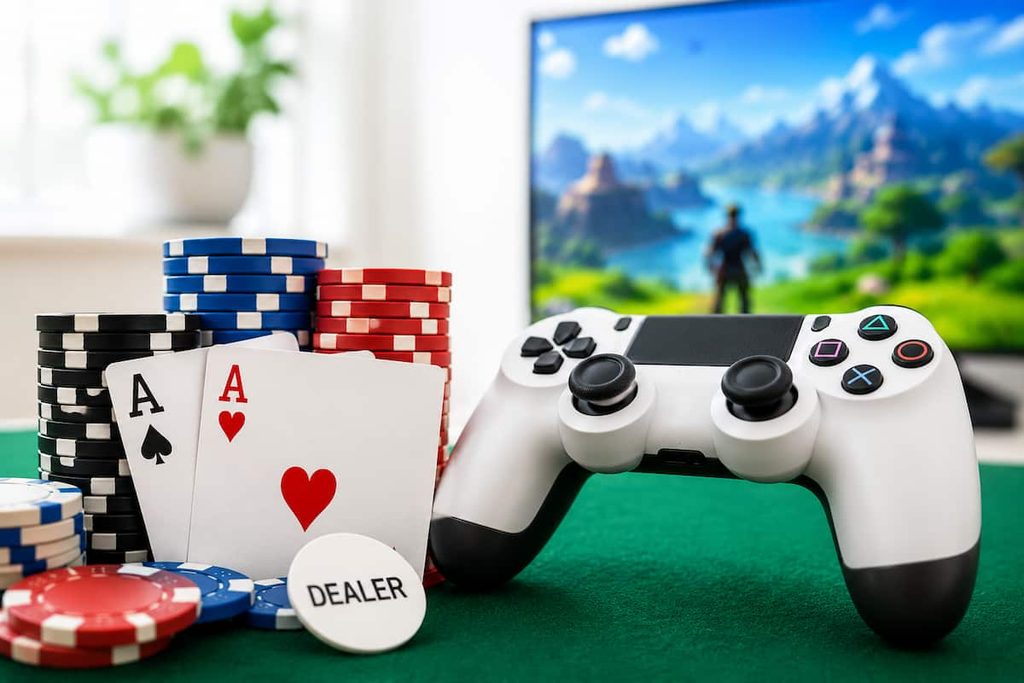
One might ask you to defeat a boss, win a race or climb a competitive ranking system. The other asks you to make the best possible decisions while somebody across the table is trying to take your chips. Yet underneath those differences, the process of becoming good at either can be remarkably similar. You fail, adapt, recognise patterns and improve. Then the difficulty increases and what worked at the previous level is suddenly no longer enough.
There is, however, one enormous difference.
Video games usually tell you when you have failed. Poker doesn’t.
That distinction might explain why gamers have plenty to learn from poker, just as poker players can learn from the way video games teach us to improve.
Video Games Teach Us That Losing Is Part of Learning
Imagine playing a difficult video game for the first time. You encounter an enemy and die. Try again. This time you recognise its attack, but dodge too early and die again.
Eventually you understand the pattern.
Your timing improves, your reactions become sharper and an encounter that once appeared almost impossible becomes manageable.
Poker players go through a similar process. They play hands, encounter unfamiliar situations, make mistakes and gradually build a library of experiences. They learn how different opponents behave, which situations repeatedly cause problems and where their own weaknesses lie. Study accelerates that process by allowing a player to revisit difficult decisions away from the pressure of the table.
The problem is that poker provides much noisier feedback.
Lose to a video-game boss because you pressed the wrong button and the mistake is often obvious.
Lose a poker hand and you might have played it perfectly.
Poker Has a Very Strange Difficulty Curve
Most games become harder because somebody designed them that way.
Early levels introduce the basic mechanics. Later levels combine them, enemies become faster, puzzles become more complicated and eventually the player encounters challenges that would have overwhelmed them several hours earlier. Good games gradually ask more of you as your ability increases.
Poker has no campaign designer controlling your progress.
You can sit down for your first game and immediately encounter somebody who has played millions of hands. You can find a soft table one evening and much stronger opposition the next. Move up in stakes and strategies that worked perfectly against weaker players can suddenly become obvious and exploitable.
That makes poker’s difficulty curve unpredictable.
It’s also one reason studying poker can feel remarkably similar to progressing through competitive gaming. You don’t simply acquire knowledge and become permanently better. You have to continually adapt that knowledge to the opponents and situations in front of you.
Our recently launched Poker DNA assessment explores a related idea. Poker players don’t all solve problems in exactly the same way. Aggression, selectivity, adaptability, analysis and composure can combine differently from one person to another. Understanding how you naturally approach decisions can be just as important as identifying the theoretically correct play.
Getting better isn’t always about copying somebody else’s game.
Sometimes it begins with understanding your own.
Gamers Already Understand Pattern Recognition
Anyone who has spent hundreds of hours with a competitive game knows the feeling.
Something happens and you react before consciously explaining why.
You’ve seen it before.
Poker players develop the same instinct. A bet size looks unusual. An opponent checks back a board where they would normally bet. A player who has barely entered a pot for an hour suddenly puts in a huge river raise. Individually, those observations don’t reveal an opponent’s cards, but experience gives the player patterns against which to compare the current situation.
The strongest players combine those patterns with probability, position, ranges and information about their opponents.
From the outside, the resulting decision can look like intuition.
Often, it is accumulated experience working very quickly.
But Poker Takes Away the Most Important Information
This is where the comparison starts to break.
Video games generally show players much of the information required to make a decision. You can see your health. You can see the opponent. You know the objective. There may be a map, ammunition counter, timer, score or other indicators constantly telling you what is happening.
Poker deliberately hides the most important information of all.
You don’t know your opponent’s cards.
That changes everything.
You aren’t solving a puzzle with all the pieces available. You’re trying to make the best decision using incomplete evidence, which means poker players have to become comfortable thinking in possibilities rather than certainties.
What hands could they have?
How frequently might they bluff? What does this particular bet size represent? What changes if their range is wider than expected? What would they do with the strongest hands?
There may never be one completely certain answer.
That is also why the crossover between poker and chess is so interesting. As we explored in what poker can teach us about chess and life, both games reward calculation, patience and pattern recognition.
Chess, however, gives both players complete information.
Poker takes away that comfort.
Winning Doesn’t Mean You Played Well
This may be the single most important lesson poker can teach someone coming from traditional gaming.
Results lie.
Suppose you get all your chips into the middle as an 80% favourite and lose. Was your decision wrong? Not necessarily. Make the same profitable decision repeatedly and you should expect to come out ahead over time, but poker makes no promise about what happens on this particular occasion.
Now reverse it.
You make a terrible call as a huge underdog and hit exactly the card you need on the river.
You won.
That doesn’t make the decision good.
Video games generally connect action and consequence more cleanly. Do something correctly and you progress. Make the wrong move and the game punishes you. Learn the correct sequence and you can often reproduce the result.
Poker can do the opposite.
It can punish excellence and reward mistakes.
Temporarily.
Poker Skill Reveals Itself Over Time
That last word matters.
Poker contains chance, but repeated performance isn’t simply random.
A major PLOS ONE study examined 456 million player-hand observations from more than 600,000 online poker players. Researchers found persistence in performance, meaning players who performed better during an earlier period were more likely to perform better subsequently. Their simulations also suggested that, within the online cash-game data studied, skill began to predominate over chance at around 1,500 hands.
That number needs context.
It doesn’t mean that after hand 1,500 luck suddenly disappears. A strong poker player can run terribly over that number of hands and considerably more. Different poker formats and playing styles can also produce very different levels of variance.
What the research demonstrates is a much broader principle.
The shorter the period you examine, the harder it becomes to separate ability from variance.
Extend the sample and skill becomes easier to see.
The Final Boss You Can Never Defeat
Every game eventually gives you something to overcome.
Poker gives you variance.
And you never beat it.
You can study ranges, improve your bet sizing and become better at reading opponents. You can fix leaks, choose better games, manage your bankroll and control your emotions. Put enough work into those areas and you can become dramatically better at poker.
But you can never become so good that the best hand always holds.
There is no level at which you unlock immunity from bad beats.
Variance cannot be defeated because it is part of the game itself.
The real skill is learning to coexist with it.
What Poker Players Can Learn From Gamers
The lessons don’t travel in only one direction.
Poker players could borrow several useful habits from serious gamers, starting with deliberate repetition.
Gamers trying to master something difficult rarely expect to succeed immediately. They repeat sections, practise combinations, study maps and watch better players. Difficult actions gradually become familiar and eventually automatic. Failure is not necessarily evidence that they should stop. Often, it simply identifies the next thing that needs work.
Poker players can approach improvement similarly.
Don’t simply play another thousand hands and assume volume automatically creates expertise.
Find the situations causing difficulty. Study them. Repeat them. Review them.
Then test yourself again.
A gamer doesn’t improve a difficult mechanic by repeatedly avoiding it.
Neither should a poker player.
Stop Treating Every Loss as Failure
Competitive gamers also become accustomed to losing.
Ranking systems virtually guarantee it.
Keep winning and eventually you encounter stronger opposition. The challenge increases specifically because you’ve demonstrated that the previous level is no longer difficult enough. Losing becomes part of finding the boundary of your current ability.
Poker players can sometimes develop the opposite instinct, particularly when money is involved.
Losing becomes evidence that something has gone wrong.
Sometimes it has.
Sometimes you’ve simply lost.
Being able to distinguish those two things is one of the hardest skills poker demands. A session therefore shouldn’t be judged only by the number displayed in the cashier. Results matter, particularly over meaningful samples, but they are a terrible tool for assessing every individual decision.
Ask better questions instead.
Were your decisions good? Did you remain disciplined? Did you identify mistakes? Did you adjust when the situation changed?
Most importantly, did you make the best decisions available with the information you had?
Those questions tell you far more about your poker than whether you happened to win tonight.
What Poker Can Teach Video Gamers
Now reverse the comparison.
What can poker teach someone who has spent years getting good at video games?
How to make decisions when there may never be a definitive answer.
That’s a powerful skill because poker regularly denies players the satisfaction of discovering exactly what happened. You can fold without ever seeing your opponent’s cards. You can make a bluff without knowing whether it succeeded because your opponent was weak or because your betting convinced them to release a stronger hand.
You can choose one line when several others might also have been profitable.
There isn’t always a replay screen telling you exactly what went wrong.
Poker forces you to become comfortable with ambiguity.
You Cannot Reload a Poker Hand
There is another important difference.
Most games let us try again.
Poker doesn’t.
You can encounter a similar situation in the future, but that exact hand is gone. The cards will be different. Stack sizes may change. Your opponent might be somebody else, or the same person behaving differently because of everything that has happened since.
There is no save point to reload.
This encourages a particular kind of discipline.
You analyse the past without expecting to change it.
Learn what you can, then move on.
That sounds obvious.
At a poker table, it can be remarkably difficult to do.
Poker, Gaming and the Art of Getting Better
Strip away the cards, chips, controllers and screens and poker and video games are both exercises in learning.
They reward pattern recognition and punish complacency. They force players to adapt as opposition becomes stronger. They demonstrate the value of practice, repetition and studying mistakes rather than simply repeating them.
Poker adds something else to the equation.
Uncertainty.
You can make the right move and lose. You can make the wrong move and win. You can become a better player without immediately seeing better results. Sometimes you will never discover whether the decision you made was correct.
That’s where poker’s lessons start extending beyond gaming.
Real life doesn’t provide perfect information either. We make decisions about careers, money and opportunities without knowing exactly what will happen next. A good outcome doesn’t always prove we chose correctly, just as a bad outcome doesn’t automatically mean we made a mistake.
Sometimes there is no perfect decision available.
All we can do is assess the information we have, consider the possibilities and make the best choice we can.
Then play the next hand.