Chess.com has spent years teaching people how to stop making bad moves. Now it wants to do the same thing with poker.
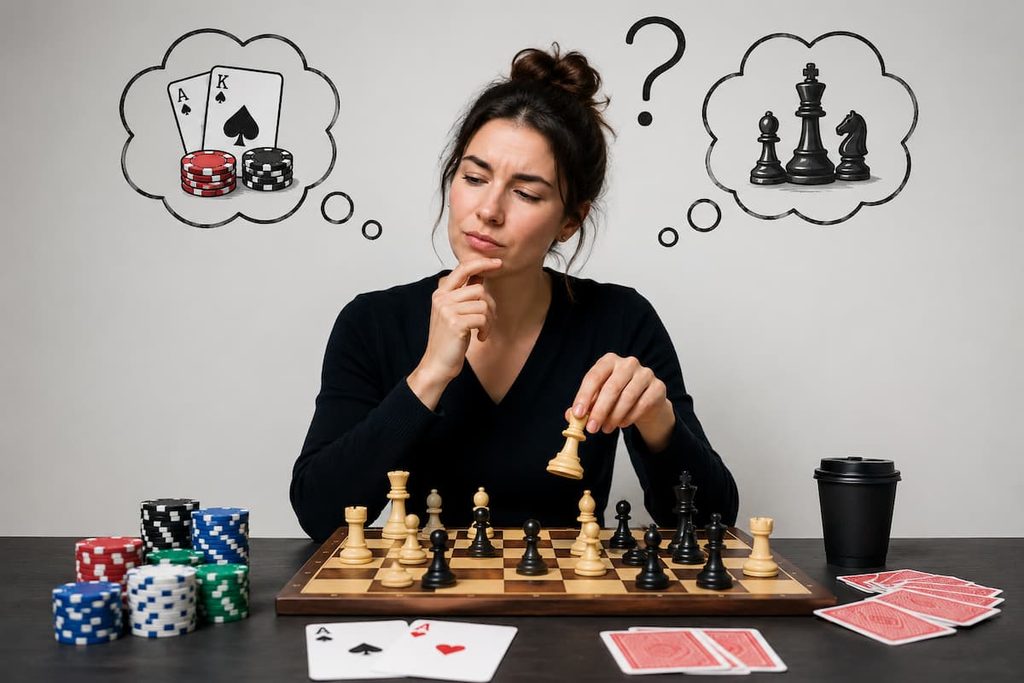
The company behind the world’s biggest online chess platform has expanded into poker with Gambit, a free-to-play training platform that takes some of the ideas familiar to online chess players and applies them to Texas Hold’em.
There are lessons, bots, hand reviews, a virtual coach, tournaments and even an Elo-style rating system.
There is deliberately no real-money poker.
It is an interesting experiment in its own right. But it also raises a much bigger question.
If the methods used to teach chess can make us better poker players, what else can games teach each other?
And perhaps more importantly, what can poker teach us when there are no cards involved at all?
Chess.com Is Trying to Teach Poker Like Chess
The basic idea behind Gambit is remarkably simple.
Instead of learning poker by depositing money, sitting at a table and discovering your mistakes when somebody else takes your chips, players can practise them.
Chess.com Chief Growth Officer Albert Cheng began developing the concept after considering whether the company’s approach to teaching chess could be transferred to another game.
Gambit entered beta in May 2026.
By early August, Chess.com said more than 45,000 people had created accounts, played 12 million hands and completed more than 100,000 lessons.
The platform has continued growing since then, with Chess.com reporting more than 85,000 members around the time of its first special Gambit Cup at the end of August.
That event attracted 1,454 players.
Clearly, chess players are at least curious about poker.
The crossover makes sense.
Both games reward study. Both contain patterns that experienced players learn to recognise. Both require players to think beyond the immediate move in front of them.
But there is also a fundamental difference.
Chess is a game of complete information.
Poker isn’t.
And that difference is where things become really interesting.
What Can Chess Teach Us About Poker?
At first glance, poker and chess appear to require similar strategic minds.
There is some truth in that.
Chess teaches players to think in sequences rather than isolated moves. Moving a bishop is rarely just about moving a bishop. The player is considering what that move threatens, how the opponent might respond and what position will remain several moves later.
Poker players should be doing something similar.
A flop bet isn’t simply a bet.
What happens if the opponent calls? Which turn cards will change the situation? What happens if they raise? Which hands are we representing? Which hands are they likely to continue with?
Thinking ahead prevents poker from becoming a succession of disconnected decisions.
Pattern Recognition Is a Powerful Poker Skill
Chess also demonstrates the enormous value of pattern recognition.
Experienced chess players don’t calculate every position from scratch. They recognise structures, threats and familiar tactical ideas because they have encountered similar situations before.
Poker works in much the same way.
A player who has studied thousands of hands starts recognising situations.
Board textures become familiar. Bet sizes provide clues. Stack depths alter possibilities. Certain lines become suspicious because we have seen versions of them before.
This is one reason serious poker study extends far beyond simply playing more hands.
Poker Type’s Ben “Bencb” Rolle profile shows how central structured study has become to modern poker. Rolle built Raise Your Edge around the idea that players can systematically improve away from the table rather than relying entirely on experience accumulated while playing.
Chess understood that principle a long time ago.
You don’t have to lose a game to learn how not to lose it.
Poker players don’t necessarily need to lose a stack to learn why putting it in would have been a mistake either.
Chess Can Also Teach Poker Players to Review Their Mistakes
This may be the most important part of the Chess.com model.
Finish a chess game and the learning doesn’t have to finish with it.
You can go back.
Where did the position turn? What did the engine prefer? Which move looked reasonable at the time but created problems later?
Poker players have traditionally been remarkably good at remembering bad beats and considerably less enthusiastic about remembering bad decisions.
That is a problem.
The river card that cost you a tournament may have been completely irrelevant to the quality of the decision you made on the turn.
Review separates the two.
Gambit’s decision to build hand reviews and coaching into the experience therefore feels less like chess invading poker and more like poker adopting a learning culture chess has already refined.
But the exchange shouldn’t only travel in one direction.
Because poker can teach chess something too.
What Can Poker Teach Chess and Other Games?
Imagine playing chess without being able to see half your opponent’s pieces.
Now imagine that some of the pieces you cannot see might not even exist.
Welcome to poker.
Chess is extraordinarily complex, but both players have access to the same board. They can see every piece and every move that has already happened.
Poker deliberately denies us information.
You know your cards. You can see the community cards. You can observe your opponent’s actions.
Everything else has to be estimated.
That changes the nature of decision-making.
Poker Teaches Us to Make Decisions Without Knowing the Answer
Poker players rarely have certainty.
They have ranges.
Perhaps an opponent is bluffing 30% of the time.
Perhaps a draw gets there roughly one time in three.
Perhaps a particular bet is profitable against most of an opponent’s likely hands but disastrous against the top of their range.
You still have to choose.
This is something poker can teach almost any strategic game.
Don’t ask only:
What is the correct move?
Ask:
What is the best decision with the information currently available?
Those are very different questions.
Poker forces players to become comfortable with probability rather than certainty.
That distinction extends far beyond games.
Poker Teaches Adaptation, Not Just Perfection
Modern poker has increasingly embraced Game Theory Optimal strategy.
Solvers can calculate theoretically strong approaches to enormous numbers of situations.
But humans don’t always play theoretically.
Sometimes they bluff too much.
Sometimes they almost never bluff.
Some players call far too often. Others fold whenever serious pressure arrives.
Against those opponents, blindly pursuing theoretical perfection can leave money on the table.
Poker therefore teaches another valuable lesson.
Learn the correct strategy.
Then look at who you’re actually playing against.
The Poker DNA assessment explores precisely these differences in tendencies. Aggression, selectivity, adaptability, analysis and composure can combine in very different ways, and one style can create particular problems for another.
The opponent matters.
That’s true in poker, chess, sport, business and almost any competitive environment.
Poker Teaches Us That the Best Player Doesn’t Always Win
This is where poker separates itself most dramatically from chess.
You can make the right decision and lose.
Not occasionally.
Constantly.
Get all your chips into the middle as an 80% favourite and roughly one time in five you are still going to lose.
That doesn’t make the decision wrong.
Chess has mistakes and consequences. Poker adds variance.
That creates one of the hardest psychological challenges in any game because human beings naturally judge decisions by outcomes.
Won = good.
Lost = bad.
Poker eventually teaches serious players that this equation doesn’t work.
A terrible call can win.
A brilliant fold can never produce a pot.
A perfectly played tournament can end with somebody hitting a two-outer.
The result cannot be the only measure of the decision.
And now we have left the poker table almost entirely.
What Can Poker Teach Us About Life?
This is where a card game played for pots suddenly becomes surprisingly useful.
Most important decisions in life look much more like poker than chess.
We rarely possess complete information.
Should you accept the job?
Start the business?
Move house?
Make the investment?
End a project?
Trust someone?
Walk away?
There is no engine waiting to tell you the objectively correct answer.
We gather the information available, estimate what we don’t know, consider the risks and make a decision.
Then life deals the river.
Good Decisions Can Have Bad Outcomes
This may be poker’s most useful lesson.
A good outcome does not prove you made a good decision.
A bad outcome does not prove you made a bad one.
Suppose someone puts their entire savings on a 100/1 outsider and it wins.
Fantastic outcome.
Terrible financial decision.
Someone else carefully researches a business, manages the risk, launches at a sensible time and fails because an unpredictable event destroys the market six months later.
Bad outcome.
Not necessarily a bad original decision.
Poker players call this variance.
Life contains plenty of it too.
The skill is learning to separate what you controlled from what you couldn’t.
Poker Teaches Us When to Fold
There may be no more useful poker expression outside the game.
You’ve already put £500 into a pot.
Then new information arrives and tells you that you’re almost certainly beaten.
Putting another £500 in doesn’t rescue the first £500.
It loses another £500.
Yet people struggle enormously with this concept away from poker.
We remain in bad investments because of how much we have already spent.
We continue projects because of the years already committed.
Companies pour money into failed ideas because abandoning them would mean admitting the earlier investment produced nothing.
The chips already in the pot are gone.
The next decision should be based on what happens from here.
Poker’s relationship with business has already demonstrated how transferable this thinking can be. As Poker Type explored in our feature on how women are using poker skills in business, the game provides a controlled environment for practising risk assessment, confidence, negotiation and knowing when abandoning an investment is actually the strongest decision.
Folding isn’t failure.
Sometimes continuing is.
Poker Teaches Emotional Control
Then somebody hits their miracle river card.
Now what?
Poker has a word for allowing frustration to affect the decisions that follow.
Tilt.
One bad result becomes two because you’re angry about the first one.
Then two become three.
The cards didn’t cause the later losses. Your reaction to them did.
Life has tilt too.
A bad meeting affects the next conversation.
An argument follows you into work.
A financial loss encourages a reckless attempt to win the money back.
A rejection makes the next opportunity feel pointless.
Poker teaches us that the next decision does not care what happened during the previous hand.
Resetting is a skill.
The best poker players aren’t emotionless. They are simply better at preventing emotion from taking control of the next decision.
Poker Teaches Us to Change
There is another lesson hidden in the careers of players who survive for decades.
The game changes.
Poker in 2026 is not poker in 2006.
Solvers changed strategy. Online poker accelerated learning. Training sites improved. Players became more aggressive and technically sophisticated.
Those who refused to change were eventually passed.
Those who adapted survived.
Daniel Negreanu provides an obvious example. His reputation was built partly around live reads and an uncanny ability to talk through opponents’ holdings. But as poker became increasingly solver-driven, Negreanu studied modern theory rather than insisting the methods that made him successful decades earlier would always be enough.
He is still winning WSOP bracelets in his fifties.
Experience is valuable.
Experience combined with adaptation is considerably more powerful.
Poker Is a Game of Decisions, Not Cards
Perhaps that is what Chess.com has really stumbled upon with Gambit.
Poker looks like a card game.
Chess looks like a board game.
Strip away the pieces, cards, chips and ratings, though, and both are really decision-making laboratories.
Chess teaches calculation, preparation, pattern recognition and the value of reviewing mistakes.
Poker takes those skills and introduces something messier.
Uncertainty.
You cannot see everything.
You cannot control everything.
Sometimes you make the correct decision and get punished for it.
Sometimes you make a terrible decision and get rewarded.
Sometimes the person sitting opposite you behaves in a way no textbook recommended.
And sometimes the strongest move available is simply to fold, preserve what you have and wait for a better opportunity.
Chess.com believes the methods it developed for teaching chess can help people learn poker.
It may well be right.
But poker has something to offer in return.
Because away from the chessboard, real life rarely gives us perfect information.
Most of the time, we’re all just playing the hand we’re dealt.