Poker has traditionally been portrayed as a battle of aggression, bluffing and nerve. Entrepreneur Jo Living believes some of its most valuable lessons are very different, and women are using them to succeed far beyond the poker table.
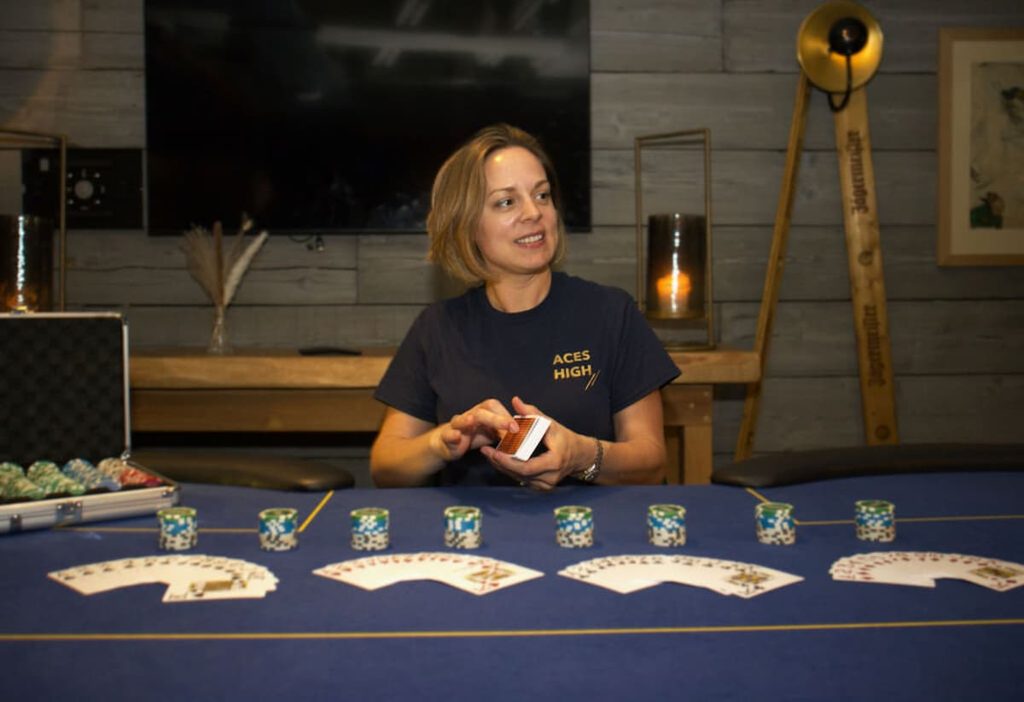
Poker can teach much more than when to raise, call or fold.
For Jo Living, founder of Aces High, the decisions players make at the table can provide lessons in negotiation, confidence, risk management and performing under pressure.
Living has taken that idea into the business world, using poker to help professionals develop skills that can be applied when negotiating deals, managing teams or simply making themselves heard.
Her own journey started with an unlikely poker victory.
In 2016, while pregnant and having played poker for only around six months, Living entered an international tournament during a trip to Morocco.
She expected her tournament to be short.
Instead, she beat around 200 opponents to win it.
It is another example of pregnancy and family life not necessarily creating a barrier between women and poker, something Poker Type recently explored in our feature on why motherhood does not end a poker career.
Teaching Women Poker Produced an Unexpected Result
Living subsequently began hosting poker games, but noticed something familiar about the players around her.
Most were men.
She started teaching women within her professional network how to play and inviting them into the games. What happened next eventually became more important than the poker results themselves.
Living says she began noticing changes in their confidence away from the table.
Some were closing client deals. Others were securing promotions or becoming more assertive when setting boundaries.
That planted the seed for Aces High, the company Living founded in 2025.
The business now uses poker-based experiences to develop workplace skills including negotiation, communication, decision-making and the ability to perform under pressure.
Living’s unusual approach to poker and professional development was explored this week in an interview with Computer Weekly, where she explained why she believes lessons learned at the table can carry directly into business.
Poker Is About More Than Bluffing
Poker’s popular image does not always help attract new players.
Movies and television have spent decades portraying the game as a contest of enormous bluffs, intimidating stares and players trying to deceive each other.
Modern Texas Hold’em is considerably more complicated.
Players are constantly making decisions with incomplete information. They have to assess risk, observe opponents, calculate what different actions might mean and decide how much value they can extract when they believe they are ahead.
Many of those decisions have obvious parallels with business.
A negotiation rarely gives either side perfect information. Neither does hiring someone, investing in a company, launching a product or deciding when to abandon an unsuccessful idea.
Poker forces players to make a decision anyway.
Knowing Your Value Matters at the Table and at Work
One of Living’s most interesting observations concerns bet sizing.
A cautious player may constantly look for the smallest amount they can risk. In business, the equivalent can be someone undervaluing their contribution or failing to ask for what they believe they are worth.
Learning to recognise a strong hand can therefore have another meaning.
Aces High says its approach is not about teaching people to dominate colleagues or bluff their way through negotiations. Instead, poker provides a controlled environment in which people can practise making decisions, communicating confidently and recognising when their position is strong.
There is an equally important lesson on the other side.
Sometimes the correct decision is to fold.
A successful poker player has to be capable of abandoning an investment when new information suggests continuing would be a mistake. The money already committed to the pot cannot be allowed to dictate the next decision.
That principle can apply to investments, projects and negotiations just as easily as a poker hand.
Why Poker Could Be Particularly Valuable for Women
There is another dimension to Living’s work.
Poker remains heavily male dominated, particularly in live environments. Sitting down at a table can therefore place women in precisely the type of situation Aces High wants participants to become more comfortable navigating.
There may be aggressive personalities. There is money or something representing value at stake. Decisions have to be made publicly and sometimes challenged by other people.
Most importantly, players cannot simply avoid making decisions.
Check, bet, call, raise or fold. Eventually, action reaches you.
For someone learning to become more comfortable asserting their value, poker provides repeated opportunities to do exactly that.
Living’s experience also challenges the assumption that aggression always means being the loudest person in the room.
Observation, patience, empathy and understanding another person’s incentives can be just as valuable.
Women Are Finding Different Routes Through Poker
Living’s story also fits into a much bigger change taking place around the game.
Success in poker no longer has to mean spending decades travelling between casinos and accumulating millions of dollars in tournament winnings.
Players are building businesses, becoming content creators, coaching, working in media and using skills developed through poker in completely different industries.
For women, that matters.
Poker has historically presented numerous barriers to participation, from overwhelmingly male live fields to the practical difficulties of combining lengthy tournaments and international travel with family responsibilities.
But there is no single definition of a poker career anymore.
A woman can be a professional player, recreational competitor, entrepreneur, creator, coach or business leader while keeping poker as part of her professional identity.
Living’s story might be one of the more unusual examples.
She entered a tournament while pregnant, beat a field of around 200 players and eventually turned the lessons she took from poker into a business of her own.
The Best Poker Skills May Have Nothing to Do With Cards
Aces High describes its approach as taking skills from the poker table to the boardroom.
There is plenty of logic behind the comparison.
Poker rewards people who can assess imperfect information, understand risk, recognise value, control emotional reactions and change their decisions when circumstances change.
Those are poker skills.
They are also business skills.
And as more women take their seats at poker tables, stories such as Living’s suggest the benefits do not necessarily end when the cards are put away.