Twenty years ago, learning poker could be remarkably simple.
Learn which hands were good. Understand roughly when to bet, call and fold. Play thousands of hands. Read a poker book. Talk about difficult decisions with other players.
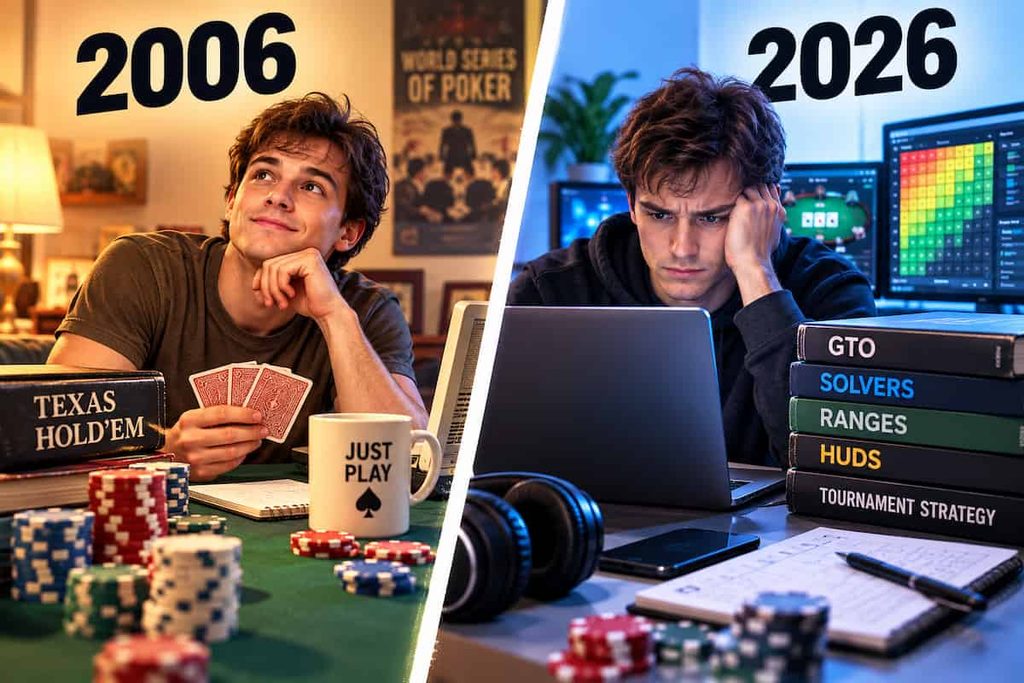
Then play some more.
A beginner discovering poker in 2026 enters a very different world. There are preflop ranges to learn, solvers that calculate theoretically optimal strategies, training platforms recreating millions of hands and HUDs capable of turning opponents into collections of statistics.
ICM matters in tournaments, while players discuss blockers, range advantage, minimum defence frequency, node locking and expected value as casually as previous generations talked about having “a feeling” somebody was bluffing. Poker players have arguably never had access to more information, but has all that knowledge created an unexpected problem?
Has poker become too difficult for beginners?
Learning Poker in 2006 vs 2026
Imagine discovering Texas Hold’em during the poker boom of the mid-2000s. You might have watched High Stakes Poker, the World Series of Poker or a televised tournament and decided to try the game yourself.
The initial barrier was remarkably low. You needed to understand the hand rankings, betting rounds and blinds, then quickly learned that pocket aces were excellent, 7-2 was terrible and playing every hand usually wasn’t a particularly good idea.
That was enough to start.
Of course, sophisticated poker strategy existed. Serious players studied books, discussed hands on forums, tracked results and analysed opponents, while online poker was already accelerating the rate at which good players could learn.
A newcomer, however, didn’t necessarily feel they needed to understand an entire technical language before sitting down. Compare that with poker in 2026 and the difference becomes obvious.
| Learning Poker Around 2006 | Learning Poker in 2026 |
|---|---|
| Poker books | Interactive training platforms |
| Starting-hand advice | Position-specific preflop ranges |
| Hand histories | Solver analysis |
| Player notes | HUD statistics |
| Poker forums | Coaching communities and video libraries |
| Pot odds | Equity calculators |
| Tight, loose, aggressive, passive | GTO ranges and exploitative adjustments |
| Experience at the table | AI-assisted analysis and simulated practice |
The game hasn’t fundamentally changed. Two cards still arrive face down, five community cards can still appear and the best five-card hand still wins at showdown, but almost everything surrounding those decisions has changed enormously.
The Beginner Is No Longer Only Competing Against Experience
Poker has always rewarded experience. Someone who has played 500,000 hands should understand situations that a player completing their first 500 hands doesn’t, but the difference today is how efficiently that experience can be supplemented.
Modern players can practise specific situations repeatedly without waiting for them to occur naturally. We recently looked at how Advanced Poker Training analysed more than 400 million simulated hands to produce exploitative starting-hand data, while modern solver platforms go considerably further.
GTO Wizard, for example, offers solver analysis, training drills, multiway solutions, node locking and structured study plans. In 2026, it became the World Series of Poker’s official poker training partner.
A dedicated player can finish a session, upload or recreate a difficult spot and investigate what theoretically stronger decisions were available. That’s extraordinary progress, but it is also what the beginner may eventually be playing against.
GTO Changed Poker’s Vocabulary
Game Theory Optimal poker has probably done more than anything else to change how serious players discuss strategy. The idea itself doesn’t make poker inaccessible because, at its simplest, GTO strategy attempts to construct decisions that opponents cannot easily exploit.
The intimidating part comes later. Open a serious strategy discussion and a newcomer might encounter ranges, frequencies, blockers, MDF, range advantage, nut advantage, equilibrium solutions and mixed strategies.
A decision that once sounded like, “I think he has a weak hand, so I’m going to bet,” can become, “This board gives my range a nut advantage, so I can use a polarised sizing at a higher frequency.” Both might ultimately result in the same chip crossing the betting line, but only one sounds like you need to complete a course before you’re allowed to play.
That creates a perception problem for poker. Advanced terminology is useful when players need precision, but when advanced concepts become the language through which basic poker is presented, beginners can mistake the ceiling of poker knowledge for the entrance requirements.
They are not the same thing.
Even Low-Stakes Players Take Poker Seriously
A newly released 2026 poker survey gives us an interesting picture of the modern player pool. Lucid Poker surveyed 1,487 players across 16 countries, although the company acknowledges that respondents were self-selected and likely skewed towards players who are more engaged with poker.
The findings therefore shouldn’t be treated as a perfect representation of everyone who plays, but the composition is still revealing.
| 2026 Poker Survey | Respondents |
|---|---|
| Serious players, but poker isn’t their main income | 62.9% |
| Play primarily for fun | 19.6% |
| Poker provides significant income | 9.1% |
| Poker is primary income | 8.4% |
| Play low stakes | 64.7% |
| Play mid stakes | 31.6% |
| Play high stakes | 2.9% |
The typical respondent wasn’t a millionaire playing super high rollers. It was a serious recreational player grinding low stakes, and that matters when considering what a genuine beginner encounters.
The traditional image of advanced poker study might involve professionals trying to gain tiny edges against other professionals. Modern poker education reaches much further down the stakes, meaning the person sitting opposite a beginner in a relatively inexpensive tournament may have studied preflop charts, reviewed hundreds of hands and spent hours practising theoretically strong strategies.
Low stakes still means the amount of money being played for is relatively small. It doesn’t necessarily mean the players haven’t studied.
The HUD Changed What It Means to Watch an Opponent
HUDs have existed for years, but they illustrate another fundamental change in online poker. Traditional poker advice tells you to watch your opponents, identify who is playing too many hands, notice who raises frequently and remember who tends to fold when challenged.
A HUD can translate much of that behaviour into numbers. Depending on the poker room and software permitted, a player might have access to statistics describing how frequently somebody voluntarily enters pots, raises preflop or behaves in particular situations.
Not every poker room treats these tools in the same way. GGPoker, for example, provides its own Smart HUD within the client, while PokerStars maintains detailed rules governing third-party tools and draws a clear line between permitted assistance and software providing prohibited real-time advice.
That distinction has become increasingly important. Studying with sophisticated software away from the table is part of modern poker, but having software tell you what to do while a hand is happening can cross into real-time assistance and cheating.
For a beginner, even understanding which tools are acceptable can therefore become another thing to learn.
Poker Has Never Been Easier to Study
There is another side to the argument because the same technology making experienced players stronger has also made learning poker dramatically easier. A beginner in 2006 could buy a book and read what a strong player thought about a particular situation, while a beginner in 2026 can actually practise that situation repeatedly.
They can watch videos for free, play against bots, access charts instantly and receive immediate feedback. The amount of educational poker material available to somebody starting today would have been unimaginable during the first online poker boom.
Chess.com has even entered poker with Gambit, a free-to-play platform built around learning, competition and practice. As Poker Type explored after the launch of Gambit, poker increasingly has access to the kind of structured learning environment that helped transform online chess.
That could be enormously important because a player doesn’t necessarily need to deposit money and lose repeatedly while learning the basics anymore. They can practise first, meaning perhaps poker isn’t harder to learn at all and we’re simply much more aware of how much there is to learn.
Beginners Don’t Need to Play Perfect Poker
This might be the most important distinction. A new poker player does not need to understand GTO, own a solver, use a HUD or memorise hundreds of preflop combinations.
They certainly don’t need to know what percentage of the time a solver wants to check-raise the turn before they’re allowed to enjoy a poker game. They need to know the rules and then start making decisions.
Bet, call, raise or fold. Watch what happens, make mistakes, understand why they were mistakes and play another hand.
The deeper strategy will still be there if they decide they want it. Poker’s enormous strategic depth is one of its greatest strengths, but the danger comes when the industry presents that depth as something a player needs to master immediately.
Maybe Poker Is Teaching Beginners Backwards
There is an interesting comparison with almost every other game. Nobody teaches a child chess by explaining 25 moves of Sicilian Defence theory before allowing them to move a pawn.
You learn how the pieces move and then you play. Eventually, you discover openings, tactics, positional concepts and endgames because you want to improve.
Poker should work the same way, yet poker education can sometimes begin with charts and instructions to open a particular range from the cutoff, three-bet a certain percentage from the big blind or abandon a specified portion of a range.
All of that can be useful advice. The problem is that the beginner may not yet understand why they are doing any of it, and there is a difference between teaching someone to reproduce the correct decision and teaching them to think about a poker hand.
Your Natural Poker Style Still Matters
Poker isn’t played by solvers. It’s played by people, and those people approach the game in very different ways.
Some players naturally attack weakness while others are cautious. Some obsess over numbers, some notice behaviour, and some remain completely composed after losing a huge pot while somebody else spends the next three hands trying to win every chip back immediately.
Those differences matter, which is one reason Poker Type’s free Discover Your Poker DNA assessment deliberately doesn’t ask players to find the “correct” GTO answer. Instead, it asks how they would naturally react.
Ten situations are used to explore five traits: Aggression, Selectivity, Adaptability, Analysis and Composure. There isn’t a perfect Poker Type, because the idea is that understanding your own tendencies can be useful before worrying about trying to imitate somebody else’s strategy.
For beginners in particular, that may be a more inviting starting point. First understand how you play, then learn how to improve it.
The Skill Gap Is Part of Poker
There is an uncomfortable truth underneath all of this: poker requires differences in ability. If everybody at a table played exactly the same theoretically perfect strategy, the game would lose much of what makes it interesting.
The recreational player matters, and so does the beginner. Today’s inexperienced player might become tomorrow’s regular, tournament enthusiast, content creator or professional, but only if their first experience makes them want to return.
Poker therefore has an incentive not merely to attract new players, but to avoid convincing them that they’re hopelessly behind before their first hand has even been dealt. The goal shouldn’t be to hide strategy from newcomers, but to show them that strategy is a journey rather than an entry requirement.
So, Has Poker Become Too Difficult for Beginners?
Yes and no.
Poker is undoubtedly more difficult to become good at than it once was. The average serious player has access to vastly better information, strategic mistakes are identified more quickly, training tools are more sophisticated and concepts once discussed primarily by elite professionals have filtered down through the stakes.
Twenty years of collective poker knowledge cannot be unlearned. At the same time, poker has become easier to learn because there are better tools, clearer explanations, free games, interactive trainers, videos, communities and almost unlimited opportunities to practise.
That creates one of the strangest contradictions in modern poker: poker has never been easier to learn, yet it may never have been harder to feel good at it.
Perhaps the answer isn’t to make poker simpler. It is to stop telling beginners they need everything at once and allow them to learn the game in the same way generations before them did.
Learn the rules and play some hands. Bluff somebody and get caught, make a ridiculous call and somehow be right, lose with pocket aces, win with a hand you probably shouldn’t have played and begin discovering what kind of player you naturally are.
Then, if you fall in love with the game, the solvers, ranges, charts and millions of hours of accumulated poker knowledge will still be waiting. Poker’s complexity is what can keep somebody interested for a lifetime, and it shouldn’t be what prevents them from playing their first hand.