A new poker mathematics preprint says it can calculate Independent Chip Model placement probabilities across fields of thousands of players, with results close to double-precision accuracy in tests. The paper, by Wataru Inariba, was posted to arXiv on October 5 and presents a method called DE-ICM.
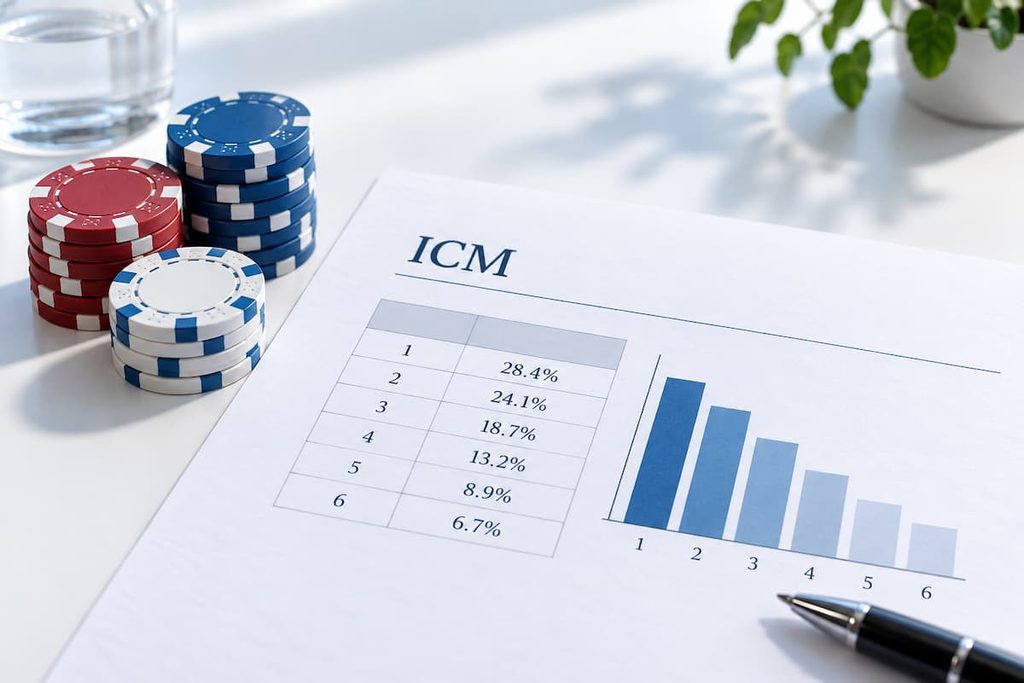
ICM estimates how a tournament’s remaining prize pool should be divided among players based on their chip stacks and the payout structure. It matters most around payout jumps, where a player’s tournament equity can differ sharply from the raw value of their chips.
The new method targets a computational bottleneck: exact ICM considers possible finishing orders, and the number of those orders grows rapidly as fields get larger. Inariba’s approach calculates placement probabilities for every player and every paid position, then those probabilities can be combined with a tournament’s payouts to estimate each stack’s prize equity.
What the paper reports
DE-ICM uses a numerical integration method to evaluate the probability that each player finishes in each paid position. The paper reports that a full placement matrix for 1,000 players took 0.2 seconds on one CPU core, while tests against exactly solvable cases extended to 4,000 players.
In those tests, the paper reports a worst observed relative equity error of 4.0 × 10⁻¹⁴ and a worst absolute placement-probability error of 1.1 × 10⁻¹⁴. Those are the authors’ measured errors on the tested instances, not a guarantee for every possible tournament or chip distribution.
The useful distinction is that the output is a set of placement probabilities, not a new poker strategy. A solver or other analysis tool could use those probabilities to value stacks under a payout schedule, but the preprint does not announce a commercial product or claim that players should change their decisions today.
Why it could matter
Faster calculations could make detailed ICM analysis more practical for larger live fields and more payout positions. The next question is how researchers and toolmakers validate the method on real tournament structures and whether they choose to build it into player-facing software.
The work also connects poker’s Independent Chip Model to the Plackett–Luce ranking model used in other fields. For poker readers, the practical takeaway is simpler: this is a research advance in calculating tournament equity, rather than a new shortcut for deciding whether to call a shove.
It follows a wider shift in poker study toward computational tools, from solver-assisted practice to discussions of whether the learning curve has become too steep. Poker Type has previously looked at how poker study moved from books to AI tools and whether the modern game is too difficult for beginners.
Inariba’s paper is available as a public arXiv preprint. Its results make a specific claim about computation and accuracy; they do not, by themselves, establish how much the method will change tournament play.