A serious poker player in 1979 could spend $100 on Doyle Brunson’s Super/System and gain access to ideas that many opponents had never encountered. In 2026, a player can open a phone, enter a tournament stack, payout structure and opponent range, then ask software to calculate a strategy in seconds.
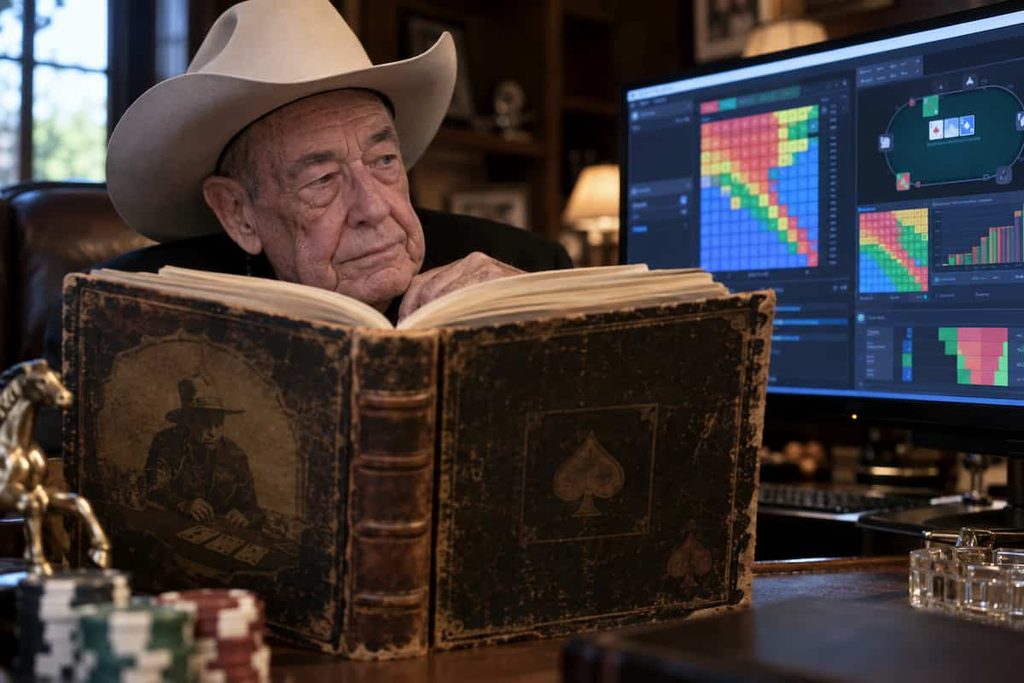
That change is bigger than poker simply moving from books to computers. The game has gone through several different learning revolutions, and each one has shortened the time between somebody discovering an edge and everybody else being able to study it.
When Poker Knowledge Was Actually Secret
Doyle Brunson’s Super/System was extraordinary partly because publishing high-level poker strategy was still a strange idea. First released at the end of the 1970s, the book brought together Brunson and specialists including Chip Reese, Bobby Baldwin, Mike Caro and David Sklansky, effectively putting professional-level thinking into the hands of anybody prepared to buy it.
The original book reportedly cost $100, an enormous price for a strategy book at the time. That price also made sense in a poker world where a single valuable idea could remain profitable for years because there was no YouTube, Discord server or solver database capable of distributing it to thousands of players overnight.
Brunson’s famous no-limit section was built around aggressive “power poker,” while the rest of the book covered games including Seven Card Stud, lowball, draw poker and limit Hold’em. Some of the detailed strategy has inevitably aged, but Super/System remains important because it represented something close to poker’s first mass release of previously guarded professional knowledge.
David Sklansky’s The Theory of Poker moved the conversation in another direction by focusing less on individual hands and more on underlying concepts. Expected value, deception, pot odds, implied odds and the relationship between your cards and an opponent’s possible holdings became part of the language serious players used to think about the game.
Harrington Gave the Poker Boom a Textbook
Then came the poker boom, when millions of new players suddenly wanted to know how to survive a No-Limit Hold’em tournament. Dan Harrington and Bill Robertie’s Harrington on Hold’em series arrived at exactly the right moment, with the first volume appearing in 2004 as televised poker and online qualifying were transforming tournament fields.
Harrington’s books popularised concepts such as the “M” ratio, which compared a tournament stack with the cost of surviving an orbit. Plenty of tournament theory has advanced since then, but for a generation of players the books provided their first structured explanation of how stack depth, position and tournament pressure should change a decision.
The scale of their influence is difficult to ignore. When 56 professional players were later asked to name influential poker books, Harrington on Hold’em Volume I topped the resulting list, ahead of Super/System, while Sklansky’s The Theory of Poker and Matthew Janda’s Applications of No-Limit Hold’em also featured prominently.
Gus Hansen’s Every Hand Revealed represented another stage in the transition. Instead of teaching poker entirely through rules, Hansen walked readers through the actual decisions behind his victory in the 2007 Aussie Millions Main Event, showing how tournament strategy could be examined one hand and one changing situation at a time.
The Internet Turned Poker Study Into a Conversation
Books had one major limitation: the reader could not argue back. Poker forums changed that because a player could post a hand history at midnight and wake up to ten different opinions about why their river call was terrible.
Sites such as Two Plus Two became unofficial classrooms for an entire generation of online professionals. Strategy developed publicly, new terminology spread rapidly and a player’s reputation increasingly depended on the quality of the arguments they could make rather than simply the size of the games they claimed to play.
Online poker created the data to support those arguments. PokerTracker and Hold’em Manager allowed players to examine enormous databases of their own hands, compare statistics by position and identify leaks that would previously have been almost impossible to measure.
This was an important change in how players learned. Instead of asking only “What should I have done in this hand?”, players could ask “What am I doing over 100,000 hands?”
Calculators Gave Players Answers Instead of Opinions
Equity calculators were another deceptively important step because they removed guesswork from basic hand comparisons. A player no longer needed to estimate how often A-K would beat queens, or how much equity a flush draw and two overcards might have against top pair.
Modern calculators can reconstruct a hand street by street and show how changing community cards alter the probability of winning. Our own Texas Hold’em Calculator sits in this part of poker’s learning history because it answers a mathematical question rather than trying to play the hand for you.
That distinction becomes important when looking at everything that came next. A calculator tells you what your equity is, while a solver tries to tell you what an entire strategy should look like.
PioSOLVER Changed What “Correct” Poker Meant
PioSOLVER’s public arrival in 2015 was one of the genuine dividing lines in modern poker study. Instead of relying on intuition, coaching convention or somebody’s forum reputation, players could construct a No-Limit Hold’em decision tree and ask software to work towards an equilibrium strategy.
That did not mean the machine produced a magical instruction for every possible poker hand. What it did provide was a way of studying ranges, bet sizes, expected values and frequencies systematically, including situations where the computer’s preferred strategy looked completely different from conventional poker wisdom.
PioSOLVER remains active more than a decade later, with its current software supporting custom post-flop trees, multiple bet sizes, range exploration, aggregation reports and a built-in trainer. The current 3.10 generation is also advertised as substantially faster than previous versions, showing how a product that once represented the cutting edge has itself continued evolving.
Solver study changed poker vocabulary almost as much as poker strategy. Players started talking routinely about range advantage, nut advantage, mixed frequencies, node locking and expected-value loss, phrases that would have sounded alien at most poker tables during the Harrington era.
PokerSnowie Took a Different Route
PokerSnowie approached the problem through artificial intelligence rather than simply presenting itself as another traditional solver. Its system was trained through enormous amounts of simulated play, allowing players to compete against the AI, import hands and receive feedback on decisions.
The platform now describes itself as an AI-powered poker training tool and allows players to analyze real hands, examine ranges and practise against its computer opponent. It says more than 220,000 players have used the product, which demonstrates how far computer-assisted study has moved beyond a small group of high-stakes specialists.
That training element matters because a solver output is not automatically a lesson. Showing somebody a grid filled with percentages can reveal an answer, but it does not guarantee they understand why the answer exists.
GTO Wizard Put the Solver in the Browser
GTO Wizard pushed solver study further towards instant accessibility. Instead of requiring players to build and calculate every tree locally, it combined huge libraries of existing solutions with browser-based training, hand analysis and increasingly sophisticated custom solving.
Its AI solver allows players to change ranges, stacks, pot sizes and betting trees before calculating new solutions in seconds. The software can also simplify strategies by evaluating possible bet sizes and identifying combinations that retain the most expected value, which is a very different experience from waiting for a large local tree to finish solving.
The 2026 version has moved well beyond simple heads-up cash-game study. GTO Wizard has introduced custom PLO solving, PLO post-flop ICM tools and, in September, preflop ICM solving that can account for custom stacks, antes, payouts and bounties with as many as nine players and tournament fields of up to 4,096 entries.
That is an extraordinary amount of calculation to place behind a browser interface. A final-table problem that once required a specialist coach and several different pieces of software can increasingly be recreated by one player sitting at home.
AI Is Starting to Explain Poker, Not Just Solve It
The most interesting development may not be faster calculations at all. Poker study software is increasingly trying to explain its answers in language ordinary players can understand.
DTO Poker now includes a Virtual Coach that provides explanations alongside GTO-based training decisions, with the company stating that the coach is powered by OpenAI. Its tournament product includes large libraries of pre-solved situations, configurable practice and instant grading, meaning the software is moving closer to the experience of having a coach sitting beside the player during a study session.
DTO also illustrates another important shift in poker software. The objective is no longer simply to provide the most theoretically detailed strategy possible, because its current products deliberately promote simplified strategies that attempt to retain almost all of the available EV while being easier for a human to execute.
That could prove more useful to most players than knowing that a particular hand bets 38% of the time for 73% of the pot. Humans have to remember strategies while playing, and nobody receives extra chips for knowing a frequency they cannot reproduce at the table.
The Newest Training Tools Are Trying to Solve the Solver Problem
Octopi Poker is a particularly good example of where poker education is heading in 2026. It combines a solver and hand trainer with The Vault, a database containing real tournament hands played by recognised professionals that can then be studied alongside solver analysis and video footage.
The newest development arrived this week. Octopi launched a “My First Solver” course on October 1 specifically because giving someone access to a solver does not necessarily teach them how to use one, while its Guided Study programme adds structured lessons rather than simply leaving players alone with millions of possible situations.
That is a fascinating reversal. Poker software originally existed because players wanted machines to supply answers, but the latest generation of products increasingly has to teach users how to understand those answers.
Poker Players Now Have the Opposite Problem
The Super/System generation suffered from information scarcity. A player might have been making the same mistake for years simply because nobody had shown them a better way to think about the situation.
The modern player faces information overload instead. GTO Wizard, PioSOLVER, PokerSnowie, DTO, Octopi, ICM calculators, tracking software, coaching sites, YouTube videos, Discord groups, databases and range charts can all be open before somebody has properly understood why position matters.
That is one reason our expanded Poker Tools section is being built around different levels of poker knowledge rather than treating every visitor like an aspiring high-stakes professional. A player learning poker hand rankings needs a completely different tool from somebody trying to understand a final-table three-bet range with ICM pressure.
More technology does not automatically produce a better poker player. A beginner who understands position, value betting, pot odds and sensible starting ranges will usually benefit more from applying those fundamentals properly than from memorising an obscure solver frequency.
Solvers Did Not Kill Exploitative Poker
One of the strangest misconceptions about modern poker is that GTO study means everybody should attempt to play like a computer. Game theory provides a powerful baseline, but real poker opponents are not equilibrium strategies.
A player who calls too often creates opportunities to value bet more aggressively. Somebody who folds far too much creates opportunities to bluff more frequently, while a player who almost never bluffs may make an apparently strong theoretical bluff-catcher an easy fold.
Modern software has actually become better at studying those deviations. Node locking allows players to tell a solver that an opponent behaves differently from equilibrium and then examine how the theoretically correct counter-strategy changes.
The technology therefore leads back towards one of poker’s oldest skills: understanding the person you are playing. The mathematics has become vastly more sophisticated, but the money still moves when one human makes a better decision than another.
The Real Edge Has Changed
Brunson’s readers gained an advantage because they possessed information their opponents did not have. Harrington’s readers learned structured tournament concepts before much of the poker-boom field had encountered them, while the first serious solver users could study strategies that most opponents had never seen.
That advantage is harder to find in 2026 because access itself has become cheap. Free preflop charts, calculators, training modes and solver outputs mean that simply owning the right book or software no longer separates somebody from the field.
The modern edge is increasingly the ability to turn information into something usable. That means recognising patterns rather than memorising grids, understanding why a strategy changes, knowing when an opponent is unlikely to behave theoretically and choosing the right study tool for the problem in front of you.
Poker study has travelled from a $100 book to an AI coach capable of discussing individual decisions in less than half a century. The technology is unquestionably better, but the final part of the process remains exactly where it was when Doyle Brunson published Super/System: the player still has to understand what they have learned well enough to make the right decision when the cards are actually in front of them.