Patrick Mansell’s What the Cards Don’t Tell You: Practical Poker Wisdom takes a refreshingly human approach to poker instruction. We examine what the book gets right, where it falls short, and which players will benefit most.
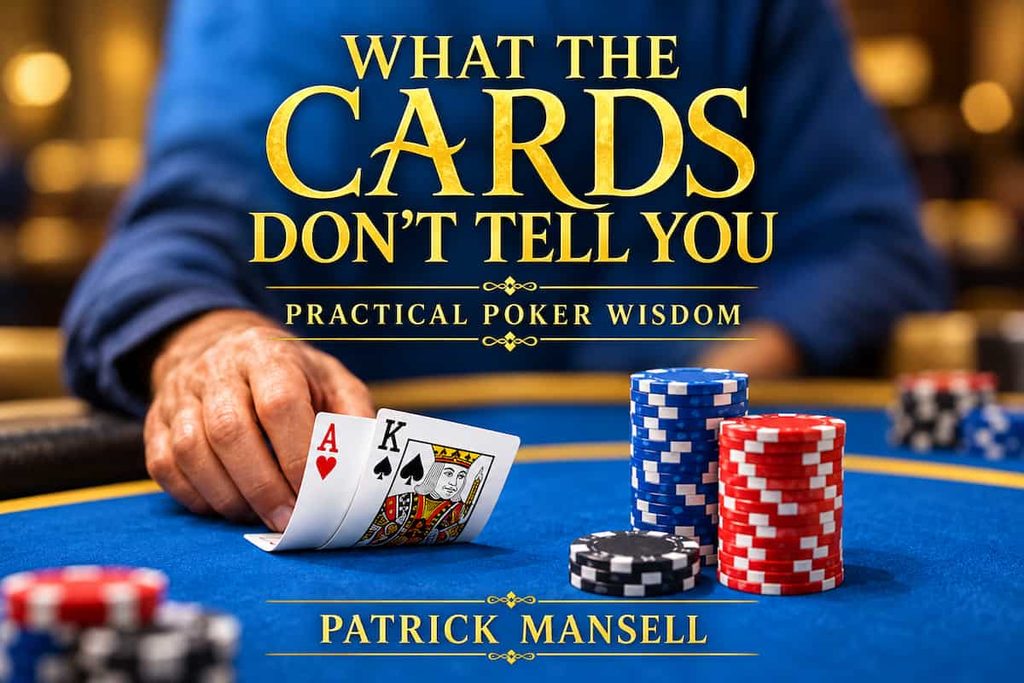
There is no shortage of poker books explaining which hands to raise, how to calculate pot odds or what a solver recommends on the turn. Far fewer address the uncomfortable reality that many players understand perfectly good strategy but abandon it the moment emotions take over.
Patrick Mansell tackles that problem in What the Cards Don’t Tell You: Practical Poker Wisdom, a thoughtful examination of the decisions, personalities and psychological traps that influence results at the poker table.
It is an accessible, frequently perceptive book that succeeds by concentrating on situations ordinary players will recognise.
Poker Advice From Someone Who Knows the Table
Mansell makes his intentions clear from the introduction. He isn’t attempting to produce another comprehensive guide to Game Theory Optimal (GTO) strategy or compete with sophisticated poker training software.
Instead, he draws upon years of live poker experience to explain why technically capable players still make expensive mistakes.
His writing is conversational, occasionally humorous and refreshingly free of unnecessary jargon. There is a genuine appreciation for poker as a social experience, something increasingly overlooked in a training environment dominated by statistics.
One particularly effective observation appears early in the book:
Good players don’t simply play good hands. They play good situations.
That distinction underpins much of Mansell’s advice. Position, stack sizes, opponent tendencies and tournament circumstances matter more than the superficial attractiveness of two hole cards.
Experienced players will recognise the principle immediately. Less experienced readers may find it changes how they approach the game.
The Psychology Is Where Mansell Excels
The strongest material concerns emotional discipline and understanding opponents.
Mansell introduces familiar poker-room characters, including the bully, the nit, the habitual caller and the self-appointed professor. These descriptions are entertaining, but they also explain how different motivations create exploitable tendencies.
His discussion of the bully is especially convincing. Players frequently make terrible calls against opponents they dislike, confusing the desire for revenge with a legitimate strategic reason to continue.
The book also handles tilt, embarrassment and impatience effectively. Mansell understands that a player who has folded for an hour may eventually manufacture an excuse to play a marginal hand.
These are observations built around recognisable behaviour rather than abstract theory.
Practical Lessons That Translate Into Better Decisions
The chapters examining drawing hands are another strength. Mansell explains why chasing a flush can be reasonable on the flop but a mistake on the turn when the price changes.
He also distinguishes between completing a draw and actually holding the winning hand, an important lesson for players who regularly lose substantial pots with second-best flushes and straights.
Elsewhere, his discussion of board reading encourages readers to adopt the detached perspective of an experienced dealer, continually reassessing what each community card changes.
One of the book’s better examples involves folding 9-4 offsuit before watching a 9-9-4 flop appear. Mansell correctly argues that the resulting full house does not retrospectively turn a sensible fold into a mistake.
This is sound poker thinking, presented without making the reader work through pages of equations.
Where the Book Could Be Stronger
The principal weakness is repetition. Discipline, patience, avoiding emotional calls and protecting chips recur throughout the manuscript, sometimes with arguments that have already been established convincingly.
A tighter structure would give several chapters greater impact.
There is also a tendency to emphasise tournament survival over chip accumulation. Mansell acknowledges that excessive caution eventually becomes dangerous, but some readers may benefit from more detailed explanations of expected value, ICM and situations where accepting elimination risk is strategically correct.
Advanced players seeking detailed range construction, balanced betting frequencies or sophisticated tournament analysis will find relatively little new technical material.
These limitations reflect the book’s intended audience rather than undermining its central message.
Our Verdict: A Worthwhile Read for Recreational Players
What the Cards Don’t Tell You works best as a practical companion to conventional poker strategy books rather than a replacement for them.
Its greatest achievement is reminding readers that understanding poker and consistently playing good poker are very different accomplishments.
Mansell does not offer revolutionary mathematical discoveries. Instead, he provides useful advice on avoiding mistakes that have been costing recreational players money for generations.
For live cash-game enthusiasts, regular local tournament players and improving recreational players, this is an engaging, largely convincing read with lessons worth revisiting.
The strongest recommendation is simple: read it before your next poker session, then pay closer attention to what happens when your cards are in the muck.
Order What The Cards Don’t Tell You
About The Author: Who is Patrick Mansell?
Patrick Mansell is an American author, businessman and former Marine Corps reservist whose writing career spans fiction, sport fishing, criminal justice and poker. After graduating from the University of Miami in 1968, he served six years in the Marine Corps Reserve while pursuing a 42-year business career. Mansell began writing books as a hobby in 1998 before becoming a full-time author following his retirement in 2012. His early work included the six-book Bimini Twist Adventures series, featuring action and adventure stories set in the Bahamas, Hawaii and Florida Keys.
Mansell subsequently turned his attention to nonfiction, producing books about legendary big-game fishermen, the history of sport fishing and the American criminal justice system. His publications include Living Legends of Big Game Fishing and The Bouncer Smith Chronicles. His interest in poker has also found its way into his writing, most recently through What the Cards Don’t Tell You: Practical Poker Wisdom. Drawing on years of experience at live poker tables, Mansell approaches the game from a recreational player’s perspective, concentrating on psychology, discipline and practical decision-making rather than complex mathematical theory.