A field of 541 entries, roughly ¥10 million in entry fees and a prize list featuring Kobe beef. On paper, the Kobe tournament had the ingredients of a decent three-day poker festival. At the end of it, however, four organisers were under investigation, and by November all four had been arrested.
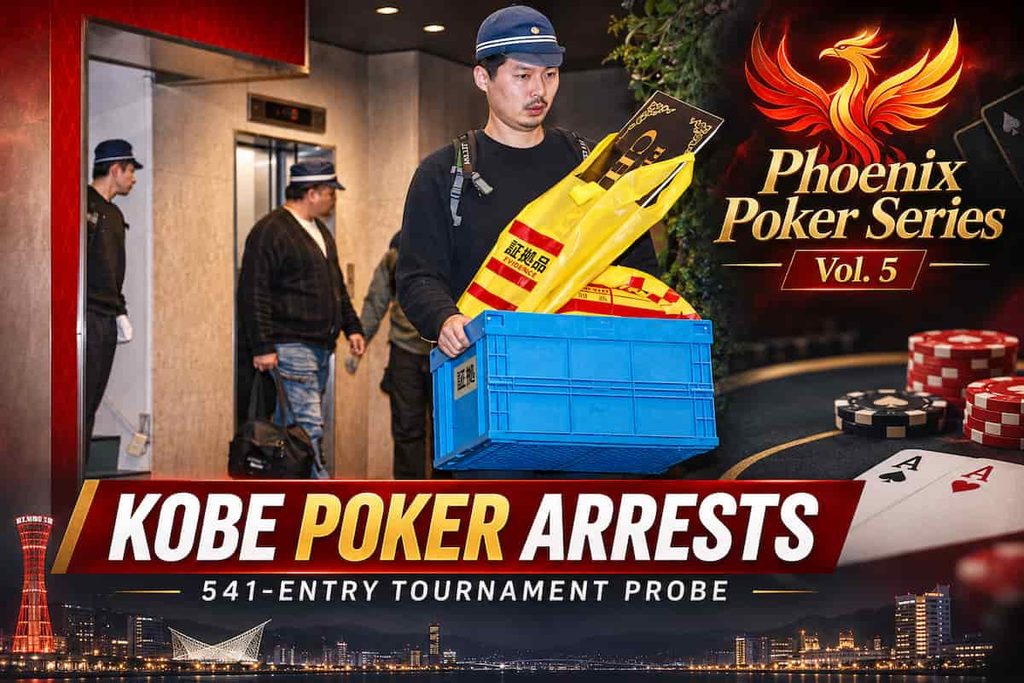
Hyogo Prefectural Police arrested four men by 17 November 2026 on suspicion of running a poker tournament without the permission required under Japan’s Entertainment Business Act. The alleged offence concerns the operation of the event, not a finding that every player who took a seat was gambling illegally. Investigators are also examining the prize arrangements separately. No conviction has been reported.
What happened at the 541-entry Kobe poker event?
The tournament took place between 24 and 26 July in a rented venue in Kobe’s Kitano area. A group using the name Hyogo Poker Federation promoted the gathering as a major local poker event. Across the three days, police say 541 entries were recorded and participants paid between ¥3,000 and ¥100,000 apiece. The reported total collected was about ¥10 million, roughly £48,000 at an approximate exchange rate.
Those figures need reading properly. The 541 number is cumulative participation, not a confirmed tally of unique players. And the ¥10 million was revenue from participation fees, not a guaranteed prize pool or an advertised first-place payout. Investigators suspect the organisers retained several million yen after expenses, a point relevant to whether the event amounted to a business requiring a licence.
Police intervened on 26 July, during the final day of the tournament, after raising concerns about the lack of a permit. The event was interrupted. Officers subsequently searched premises linked to the organisers on 9 November and seized equipment, before the arrests were reported later that month. The case therefore did not begin with a surprise arrest after a trouble-free tournament; police attention had already disrupted the action in July.
| Detail | Reported position |
|---|---|
| Venue | Rented event space in Kitano, Kobe, Japan |
| Event dates | 24–26 July 2026 |
| Participation | 541 cumulative entries over three days |
| Entry fees | ¥3,000–¥100,000 |
| Fees collected | Approximately ¥10 million |
| Prizes mentioned | Kobe beef and points or credits usable at other events |
| Police intervention | 26 July; related search reported on 9 November |
| Arrests | Four organisers, by 17 November 2026 |
| Alleged offence | Unlicensed amusement-business operation |
Police describe this as the first Japanese case in which poker tournament organisers have been arrested on suspicion of this particular unlicensed-business offence. It should not be confused with allegations of running a cash gambling ring. PokerType previously covered a separate police operation involving a poker venue in Shinjuku, where the reported circumstances were different.
Three warnings, then a tournament anyway
One of the biggest questions is why the event went ahead despite police concerns. Local reporting says the organisers had been warned three times that the proposed tournament could require permission, yet they proceeded. The organisers reportedly believed poker should be regarded as a competition rather than a regulated amusement activity. They also questioned whether an event lasting three days counted as an ongoing business.
Those arguments are not frivolous questions for tournament promoters, but they do not settle the law. A card room’s label, tournament branding or use of non-cash prizes does not decide whether Japanese licensing rules apply. The men have reportedly disputed parts of the allegations, and the case is still an allegation, not a conviction.
The prize structure is another issue. Reported rewards included Kobe beef and points or coins that could be used at later tournaments. Authorities are investigating whether those arrangements may raise gambling concerns. It is important to separate the confirmed arrest allegation, unlicensed business activity, from any possible additional charge involving gambling. That second question has not been resolved by a court.
What does Japanese law say about poker tournaments?
The argument boils down to whether a tournament is operating as a regulated amusement business. In October, the Japan Poker Business Association (JPBA) hosted an official briefing by Japan’s National Police Agency. The association’s published explanation of the police briefing sets out two factors that matter for tournaments: profitability and continuity.
- Profitability: officials consider whether participation fees exceed reasonable tournament set-up and running costs, including the venue, staff, administration and promotion.
- Continuity: a tournament held over two days or more can satisfy this condition. Repeated one-day tournaments less than six months apart can also count.
- Permission: where both elements are present and the operation falls within the regulated Type 5 amusement-business category, the relevant prefectural Public Safety Commission may need to approve it.
- Prize restrictions: licensed amusement businesses are subject to separate limits on giving prizes or other financial benefits according to game results.
That means the maths behind an entry fee matters just as much as the blind structure. Imagine an event takes ¥8 million from players but can substantiate only ¥5 million in reasonable running costs. That would raise a very different profitability question from a tournament whose participation fees merely cover defensible expenses. Those figures are an illustration, not the Kobe event’s actual accounts.
There are wrinkles too. The JPBA says sponsorship, advertising or merchandise income should not simply be treated as identical to participation fees. But that does not give organisers a loophole to relabel what is effectively the price of taking a seat. Authorities consider how the operation really works, not just what appears on the flyer.
The National Police Agency’s official amusement-business guidance addresses permission and prize restrictions. It is background on the law, not an official ruling on the guilt of the four men in Kobe.
Why Kobe matters beyond one tournament
The timing is uncomfortable for a Japanese poker scene that has been trying to grow legitimate domestic competition. PokerType has already covered the cancellation of WPT Tokyo 2026 amid regulatory uncertainty. Organisers of that event were unwilling to push ahead without satisfactory clarity on their legal exposure.
There has also been attention on how domestic festivals award prizes. Our reporting on the Japan Open Poker Tour’s revised Ladies Championship rewards raised questions about how benefits are structured and presented. The legal position of that tournament cannot be inferred from the Kobe allegations, but both demonstrate why a prize list has become more than an attractive line on a tournament poster.
Meanwhile, Japanese players continue to make an impression at international events. PokerType has looked at Japan’s growing presence at the World Series of Poker. The strength of Japanese players abroad and the rules governing domestic events are two different stories. One does not solve the other.
What should tournament directors take from the case?
Before taking registrations in Japan, organisers should be able to answer the questions that any decent tournament director would ask about the business side: What are the participation fees buying? How much will it really cost to run the event? Is it a one-off or part of a recurring schedule? How are prizes, credits and future-event entries awarded? And has the plan been checked with the local prefectural police and Public Safety Commission?
It is possible to run a well-structured tournament and still lose the argument over licensing. A clean clock, competent dealers and fair blind levels do not replace the paperwork. Nor does describing the event as a sporting competition automatically take it outside the rules.
The four organisers have not been convicted, and the investigation into the prizes is still separate from the reported licence allegation. For now, the Kobe case is a reminder that the biggest leak in a poker festival can have nothing to do with a river call. If the organisers have not dealt with the legal structure before the first card comes off the deck, every player and venue involved can be left wondering what happens next.