Sit down at a poker table in New Mexico and something rather important is missing.
The dealer.
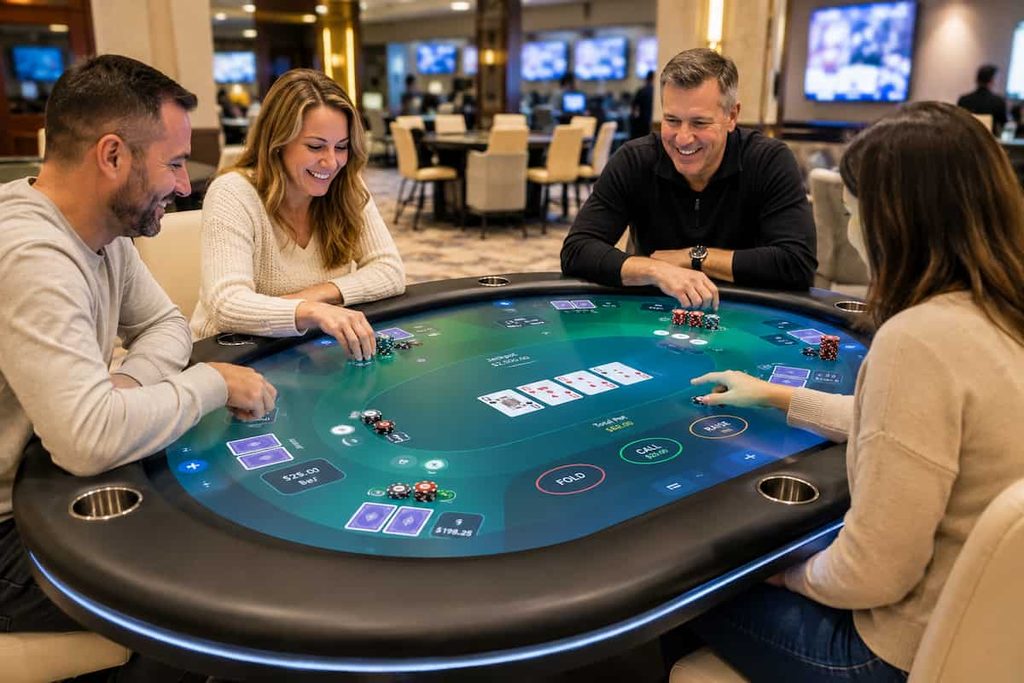
There are still eight seats. There are still opponents sitting across the table. There are still bets, raises, folds, bad beats and presumably somebody insisting they would have won if they had called the river.
But there is no dealer pitching cards across the felt. No stacks of chips to count. No deck to shuffle.
The table does it instead.
The arrival of two Jackpot Blitz dealerless poker tables at Inn of the Mountain Gods Resort & Casino in New Mexico might look like another relatively minor piece of casino technology news.
Look at what is happening across poker, however, and it starts to feel like part of something much bigger.
Poker has spent the past 25 years gradually handing jobs once performed by people to software. Now artificial intelligence is accelerating the process.
Machines can deal the game. Software can analyse our hands. Solvers can tell us how close our decisions were to theoretically optimal play. AI has defeated elite professionals. Experimental systems are even attempting to interpret physical poker tells.
Technology isn’t simply changing how we play poker anymore.
It is changing how many humans poker actually needs.
First the Dealer Disappears
Jackpot Digital announced on August 25 that two of its Jackpot Blitz electronic tables had gone live at the Mescalero Apache Tribe-owned Inn of the Mountain Gods.
The company describes Jackpot Blitz as a fully automated poker table.
Players sit around a large touchscreen and play against each other, retaining the communal element of live poker while software takes care of much of the work traditionally performed by a dealer.
There are obvious attractions for a casino.
A machine doesn’t need a break. It doesn’t call in sick. It doesn’t misdeal. It doesn’t incorrectly count a pot. It can operate whenever players want a game and potentially allow casinos to offer poker in locations where staffing a conventional poker room isn’t economical.
Jackpot Digital is increasingly taking that proposition around the United States. The company announced its largest agreement to date in July, involving eight tables for Pechanga Resort Casino in California, following other deployments across the US and Caribbean.
The technology solves genuine problems.
But it also removes one human being from every table it replaces.
And in poker, the dealer isn’t just a mechanism for distributing cards.
Good dealers know the regulars. They keep games moving. They calm arguments. They share jokes. They remember the player who always asks for a seat change. They are part referee, part host and occasionally part therapist.
Anyone who has spent hundreds of hours in a poker room knows that dealers become part of its personality.
A touchscreen can distribute cards more efficiently.
It cannot tell you what happened to Dave who used to play the Tuesday night game.
At least, not yet.
Poker Has Been Automating Itself for Years
Dealerless poker didn’t arrive from nowhere.
We have been removing physical elements from the game for decades.
Online poker performed the biggest disappearing act.
Suddenly there was:
- no dealer
- no physical deck
- no chips
- no casino
- no need to see your opponents
- no requirement for the players to even be in the same country
Yet poker survived.
More than that, online poker created an enormous new version of the game.
The convenience was irresistible. Hands were faster. Multiple tables could be played simultaneously. Games were available around the clock. Someone sitting in their bedroom could compete against players thousands of miles away.
What disappeared in return was much of the human information poker had traditionally relied upon.
You couldn’t see nervous hands.
You couldn’t hear somebody talking too much when they were bluffing.
You couldn’t watch an opponent stare at the flop.
Players adapted.
Then technology gave them something else instead.
Data.
The Opponent Became a Set of Numbers
Online poker allowed enormous quantities of information to be collected about how people played.
Eventually, opponents weren’t simply Dave, Sarah or Mike anymore.
They could become statistics.
VPIP.
PFR.
Three-bet percentage.
Fold to continuation bet.
Thousands upon thousands of hands could reveal tendencies that no human memory could realistically track unaided.
Poker had begun replacing observation with measurement.
That didn’t eliminate skill. It created a different kind of skill.
The best players learned how to understand the information and use it better than everybody else.
Then came the solvers.
And poker changed again.
Then Software Started Telling Us How to Play
For generations, poker strategy was passed between people.
Players discussed hands with friends. Books were written by successful professionals. Coaches charged for their experience. Strategy forums became enormous communities where players argued over whether somebody should have bet the turn.
There was rarely a definitive answer.
That uncertainty was part of poker.
Modern solver technology changed the conversation.
Feed a situation into sophisticated software and it can calculate strategies humans would struggle to construct independently.
Sometimes the answer is intuitive.
Sometimes it is bizarre.
A tiny bet where almost every human player would have checked. A bluff with a hand nobody previously considered bluffing. A mixed strategy that requires taking different actions with the same cards at carefully calculated frequencies.
The effect at the top of poker has been enormous.
As we noted when looking at Jason Koon’s evolution through modern high-stakes poker, elite players now operate in an environment shaped by solvers, databases and increasingly sophisticated game-theory analysis.
The poker brain hasn’t disappeared.
But it has acquired a very powerful electronic colleague.
The Poker Coach Is Changing Too
Artificial intelligence pushes this another step.
Imagine showing software a hand you played and asking:
Where did I go wrong?
Instead of waiting for a coach, posting on a forum or spending an hour navigating solver outputs, an AI system can potentially explain the hand conversationally.
Ask another question.
Challenge the answer.
Change the stack sizes.
Ask how the strategy changes against a recreational player.
Ask it to explain the concept more simply.
The barrier between recreational players and sophisticated poker analysis is shrinking.
That sounds wonderful for education.
It also raises an uncomfortable question.
If a machine deals the cards and another machine teaches us how to play them, how much of poker remains exclusively human?
AI Already Beat Us at Our Own Game
This isn’t theoretical.
Artificial intelligence has already demonstrated that it can play extraordinary poker.
In 2017, Libratus defeated leading professionals in heads-up no-limit Hold’em.
DeepStack provided another breakthrough in heads-up poker, and the researchers behind it eventually took ideas developed around poker’s imperfect-information problems into the financial world. Their subsequent company, EquiLibre Technologies, reached a $500 million valuation after poker AI helped provide foundations for technology aimed at vastly larger markets.
Then came Pluribus.
Developed by researchers at Carnegie Mellon University and Facebook AI, Pluribus demonstrated superhuman performance in six-player no-limit Hold’em.
That was particularly significant because multiplayer poker introduces complexities that don’t exist in a heads-up game.
Poker had often been considered an especially interesting challenge for AI precisely because it isn’t chess.
Everyone can see a chess board.
Poker hides information.
You don’t know what your opponent holds. They might deliberately deceive you. You have to make decisions under uncertainty while considering what other people believe about your own actions.
Bluffing feels intensely human.
Yet AI learned to bluff too.
The machine didn’t need sunglasses.
It didn’t need a heartbeat.
It needed mathematics.
Now AI Wants to Read Our Faces
There was always one apparent refuge for humans.
Physical tells.
A computer might understand betting frequencies, but could it notice somebody suddenly sitting differently after seeing the river?
That boundary is being tested too.
During coverage of the 2026 WSOP Main Event, viewers saw an experimental AI-powered tells system attempting to interpret player behaviour.
Poker Type examined the question in Can AI Really Read Poker Tells?.
The answer, for now, is reassuringly human.
Not reliably.
Experienced live players combine far more than a facial movement when making a read. They consider betting patterns, previous hands, timing, stack sizes, table dynamics, physical behaviour and their accumulated experience with an opponent.
AI can recognise patterns.
Understanding why a person made them is another matter.
But the important words are for now.
Twenty years ago, asking whether software could beat the world’s best players at complex multiplayer no-limit Hold’em would have produced plenty of scepticism too.
It eventually did.
Poker Is Following the Rest of Our Lives
This is where the story becomes bigger than poker.
Look around.
People are already asking artificial intelligence to write emails, analyse spreadsheets, create images, summarise meetings, translate languages, plan journeys, write computer code and explain subjects they don’t understand.
The transformation rarely happens dramatically.
Nobody wakes up one morning to discover that every human role has disappeared.
Instead, a small task goes first.
Then another.
The machine does something faster, so we let it.
It does something cheaper, so businesses adopt it.
It becomes more convenient, so customers accept it.
Eventually something that once required several people requires one.
Or none.
Poker is experiencing exactly that process in miniature.
Think About What Has Already Changed
A modern poker ecosystem can now contain technology that:
- deals an entire live poker game without a human dealer
- calculates sophisticated strategies beyond unaided human capability
- records and analyses enormous databases of player behaviour
- trains players using software rather than another person
- detects suspicious online playing patterns
- attempts to identify physical tells
- processes tournament entries digitally, including the $22.9 million in Solana payments made at the 2026 WSOP
Not every item on that list is artificial intelligence.
That’s important.
Automation and AI are different technologies.
But they are moving in the same direction: taking something previously performed or interpreted by a human and giving at least part of the job to a machine.
There Is One Huge Problem: AI Can Also Destroy the Game
There is another side to this technological revolution.
Poker only works when the humans playing believe the other players are actually making their own decisions.
An AI poker coach used after a session is one thing.
An AI system telling somebody what to do while the hand is happening is something completely different.
That is why real-time assistance has become such an important integrity issue in online poker.
The nightmare scenario isn’t necessarily an unbeatable robot sitting openly at a table.
It is a human appearing to play while quietly outsourcing decisions to software.
If players stop believing their opponents are genuinely making their own choices, online poker has a fundamental trust problem.
Technology therefore finds itself occupying both sides of the battle.
Software can potentially help somebody cheat.
More sophisticated technology is then required to catch them.
The arms race continues.
Could We Eventually Have a Poker Game With Almost No Human Infrastructure?
Push the technology far enough and the possibilities become strange.
Imagine a future tournament.
Registration is automated.
Cryptocurrency or another digital payment method handles the buy-in.
A dealerless table runs the game.
AI monitors play for suspicious behaviour.
Software handles rulings.
AI generates statistics for the broadcast.
Another system identifies interesting hands.
AI commentary explains them to viewers.
An automated tournament system balances tables and moves players.
When the session ends, an AI coach analyses every decision a player made.
The only indispensable humans left are the players.
And even that qualification becomes awkward when we remember that poker AIs have already defeated world-class professionals.
Would that still feel like poker?
Technically, absolutely.
Emotionally, perhaps not.
What Happens to Poker’s Characters?
Poker has never really been compelling because 52 pieces of cardboard can be arranged into different combinations.
People make poker interesting.
Doyle Brunson staring across the table.
Phil Hellmuth exploding after a bad beat.
Daniel Negreanu talking through a hand.
A nervous amateur trying not to reveal that they have flopped a monster.
The dealer who has heard the same joke 400 times and still laughs.
The stranger beside you who somehow tells you their entire life story before the second break.
Poker rooms are peculiar social environments.
Players compete against each other for money while simultaneously spending hours talking, laughing, arguing and sharing experiences.
Efficiency isn’t necessarily the point.
That is the danger when we judge every technological improvement purely by what it makes faster.
A dealerless table may deal more hands.
A solver may produce a better strategy.
An AI coach may analyse a hand more accurately.
But better poker isn’t automatically the same thing as more efficient poker.
Technology Has Improved Poker Too
None of this means poker should reject technology.
That would be absurd.
Online poker made the game accessible to millions.
Streaming transformed how people watch it.
Modern study tools have pushed strategic understanding to extraordinary levels.
Digital payments are making casino processes easier, with the rapid adoption of crypto payments at the WSOP demonstrating how quickly players can embrace a useful technological change.
Dealerless tables could keep poker alive in casinos where running a conventional room isn’t financially realistic.
AI could improve security.
It could make sophisticated poker education affordable.
It could help broadcasters explain difficult concepts to recreational viewers.
The question isn’t whether technology belongs in poker.
It already does.
The more interesting question is what we don’t want it to replace.
How Much Humanity Does Poker Need?
Perhaps poker ultimately provides a useful test case for the wider AI age.
Because poker isn’t simply a task.
It is a social game built around uncertainty, deception, psychology, mathematics and people.
If technology can gradually automate even that, it tells us something about what may happen elsewhere.
The biggest change probably won’t arrive as a dramatic moment when somebody announces that AI has taken over poker.
It will happen quietly.
A solver here.
An automated table there.
An AI coach on your phone.
Software watching for cheating.
An algorithm analysing your face.
Each development will have a perfectly reasonable justification.
Faster.
Cheaper.
Safer.
Smarter.
More convenient.
None of them individually kills poker.
Most may improve it.
But if we keep removing the inefficient, unpredictable and occasionally annoying humans from the game, we may eventually discover that those humans were responsible for much of what made poker worth playing in the first place.
The cards will still be dealt.
The bets will still be made.
The mathematics will probably be better than ever.
We may just look around the table one day and wonder where everybody went.