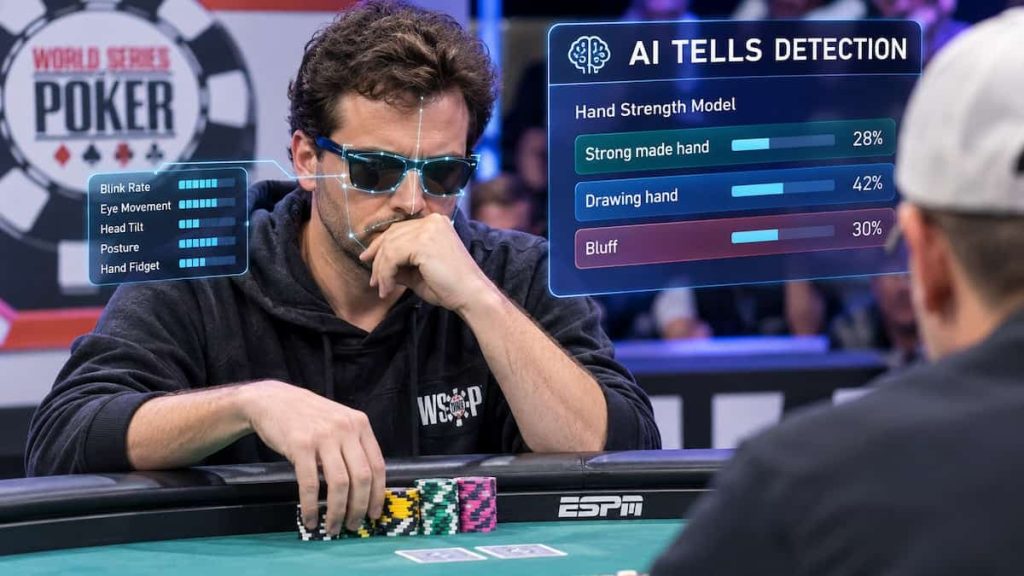
Artificial intelligence is finding its way into almost every industry, and poker is no exception. During ESPN’s coverage of the 2026 World Series of Poker Main Event, viewers were introduced to an experimental AI-powered “tells detection” feature that attempted to predict whether players were bluffing, drawing, or holding strong hands based purely on their physical behavior.
For casual fans, it looked like something straight out of the future. For many professional players, however, it raised a much bigger question.
Can AI really read poker tells, or is it simply making educated guesses?
What Was the WSOP AI Tell Detection Tool?
The experimental feature appeared during selected broadcasts from the early stages of the 2026 WSOP Main Event. On-screen graphics measured a player’s movements while also displaying a “hand strength model” that estimated the likelihood they held a premium hand, a drawing hand, or even a bluff.
The technology was developed by AI engineer Luke Geel and built using footage captured from the tournament’s televised feature tables. Rather than analyzing betting strategy or previous hands, the system focused on physical behavior, including:
- Eye movement
- Blink rate
- Body posture
- Chip handling
- Hand fidgeting
- Other visible movements
The AI then compared those observations with the eventual showdown results to identify patterns that might indicate confidence, weakness, or deception.
It certainly made for compelling television. Whether it actually revealed anything useful is another matter entirely.
Why Many Poker Pros Aren’t Convinced
Professional poker players spend years learning how to spot physical tells, but most believe that experience cannot simply be replaced by artificial intelligence.
One of the biggest criticisms is the amount of data available.
Although more than 9,000 players entered the 2026 WSOP Main Event, only a small percentage ever appeared on the televised feature tables. Even those players often spent just a few hours on camera before moving to another table or being eliminated.
Final table player Michael Gagliano explained that he personally reviewed every available broadcast during the break before the final table, searching for useful information on his remaining opponents.
Despite hours of footage, he admitted there simply wasn’t enough information to confidently identify meaningful tells that could influence major decisions.
If a seasoned professional struggles to draw conclusions from that amount of video, expecting an AI model to consistently outperform human judgment may be asking a little too much.
Poker Tells Are More Than Body Language
Hollywood has helped create the impression that poker tells are obvious.
Many fans still remember Rounders, where Matt Damon’s character spots Teddy KGB’s famous Oreo cookie habit before making the biggest fold of the film.
Real poker isn’t quite so simple.
According to multiple-time WSOP Player of the Year Shaun Deeb, physical tells extend far beyond what television cameras can capture. Players often watch for breathing patterns, leg movements, pulse changes, verbal responses, timing differences, and dozens of other subtle behaviors that may never appear on a broadcast.
Even when cameras capture a player’s face perfectly, interpreting that information isn’t straightforward.
A nervous player isn’t necessarily bluffing.
Likewise, someone sitting confidently behind a large bet doesn’t automatically have the nuts.
Context Matters More Than Confidence
One of the biggest limitations of AI tell detection is understanding why someone behaves a certain way.
A recreational player might genuinely believe two pair is an unbeatable hand, displaying complete confidence while actually holding a vulnerable hand.
An experienced professional facing a huge river decision for millions of dollars might show visible tension despite holding the strongest possible hand.
The same body language can represent entirely different situations depending on the player, the tournament stage, stack sizes, opponent tendencies, and even personality.
AI can recognise patterns.
Understanding intent is far more difficult.
Could AI Eventually Become Useful?
That doesn’t mean the technology has no future.
High-stakes professionals already spend hundreds of hours reviewing streamed footage before major tournaments, looking for betting patterns, timing tells, and physical habits.
Artificial intelligence could eventually help organize that information far faster than humans ever could.
Instead of replacing poker expertise, AI may become another study tool, highlighting potential tendencies for players to investigate further.
Even Geel, the creator of the system, acknowledged that larger datasets would likely improve accuracy, while noting that testing on other poker events has produced mixed results.
Why Was the AI Missing From the Final Table?
Perhaps the most interesting twist came during the WSOP Main Event finale.
Although the AI graphics appeared during earlier broadcasts, they were absent from the final table coverage.
According to the report, an Omaha Productions representative confirmed the feature would not be used during the championship broadcast but declined to explain why.
Whether that decision reflected production choices, concerns over accuracy, or something else entirely remains unknown.
So, Can AI Really Read Poker Tells?
Not yet.
Today’s AI can identify physical patterns, measure movements, and detect behavioral changes that might escape casual viewers.
What it cannot reliably do is understand the countless psychological and strategic factors that make poker such a uniquely human game.
Professional players don’t simply watch how someone acts. They combine physical tells with betting history, stack dynamics, player tendencies, previous hands, table image, tournament pressure, and years of experience before reaching a conclusion.
For now, AI appears to be an interesting broadcast enhancement rather than a revolutionary poker tool.
As the technology improves, that may eventually change.
But if Shaun Deeb had to choose between artificial intelligence and an experienced team of live tells specialists today, his answer was refreshingly simple.
“I would take my team versus the AI,” he said. “And make a bet on it.”