Solana’s first World Series of Poker partnership resulted in almost $23 million worth of crypto-powered tournament entries during the 2026 series in Las Vegas.
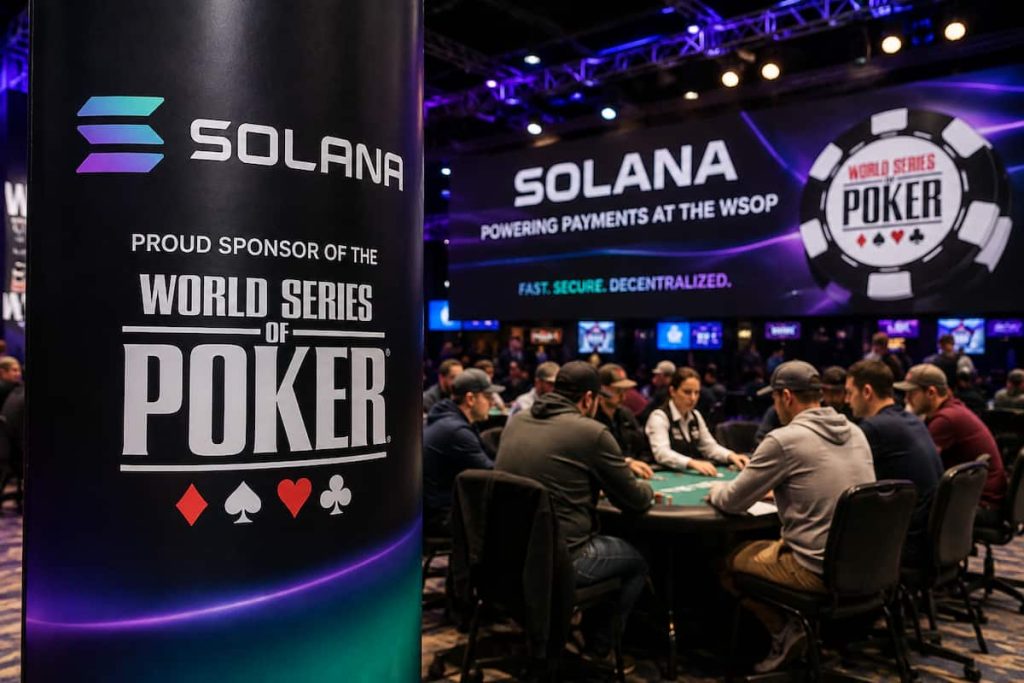
Players used the new payment option for 6,176 WSOP entries worth a combined $22.9 million, according to figures shared by Solana Foundation Chief Product Officer Vibhu Norby.
That represented more than 5% of the total money spent on tournament buy-ins during the series, giving the WSOP’s first experiment with direct cryptocurrency payments significant adoption in its debut year.
More Than 6,000 WSOP Entries Paid for Through Solana
Solana became the presenting sponsor of the 2026 World Series of Poker as part of a partnership that went considerably further than putting its branding around the tournament venues.
For the first time in WSOP history, players were able to purchase tournament entries directly using cryptocurrency.
MoonPay provided the payment infrastructure behind the system, allowing players to use Solana-based payments without processing fees.
By the end of the Las Vegas series, 6,176 entries had been processed through the system for a total value of $22,889,450.
The figures also suggest crypto payments were particularly popular among players entering more expensive tournaments. The average Solana-paid entry was approximately $3,706, compared with around $2,053 for entries purchased through other payment methods.
Solana’s WSOP Partnership Went Beyond Sponsorship
When the partnership was announced in June, the scale of its practical involvement in the WSOP was still an unknown.
As Poker Type reported at the time, the agreement brought Solana and MoonPay together to provide a new payment route for players at the 2026 WSOP.
The eventual $23 million total shows the system was used for considerably more than a small trial.
Norby has since described the WSOP agreement as Solana’s first sponsorship of its kind, with the company attracted by the opportunity to introduce an actual product rather than simply gain exposure from its branding.
There is also considerable crossover between the poker and cryptocurrency communities, particularly among players accustomed to moving money internationally and competing in high-stakes events.
Crypto Payments Could Become Even More Important at WSOP Paradise
The Las Vegas integration concentrated on getting money into tournaments, but the next stage could have an even bigger impact on how poker players move funds.
The partnership is scheduled to expand at WSOP Paradise in The Bahamas later in 2026, where tournament winners will have the option of receiving settlements in stablecoins on Solana.
That could be particularly useful for international players who would otherwise need to navigate traditional banking systems when receiving tournament winnings abroad.
The WSOP and Solana have promoted the technology as a way of reducing payment friction while providing faster access to funds.
After nearly $23 million was already processed during the Las Vegas series, WSOP Paradise will provide another test of how willing poker players are to use cryptocurrency not only to enter tournaments, but also to receive their winnings.
Solana Also Brought Crypto Players to the Poker Tables
The partnership was not limited to payments.
During the 2026 WSOP Main Event final table, Solana was involved in the $100,000 WSOP Solana Showdown, a nine-player event featuring personalities from the cryptocurrency world.
The tournament also involved 2006 WSOP Main Event champion Jamie Gold, who provided coaching to the recreational players before they competed.
Crypto trader Rasmr eventually won the event and collected $50,000, with runner-up MinhxDynasty taking $25,000.
The event demonstrated another side of the partnership: introducing poker to an audience already comfortable with cryptocurrency rather than simply encouraging existing poker players to adopt a new payment method.
With thousands of entries and almost $23 million already moving through the system during its first WSOP, Solana’s involvement in poker has quickly developed into something more substantial than a conventional sponsorship deal.