Doyle Brunson was poker’s biggest name, but when Texas Dolly arrived in London in 2010 to promote his online gambling ventures, the legendary Texan wasn’t in the mood for small talk. What followed became one of the most memorable interviews of a 20-year poker media career.
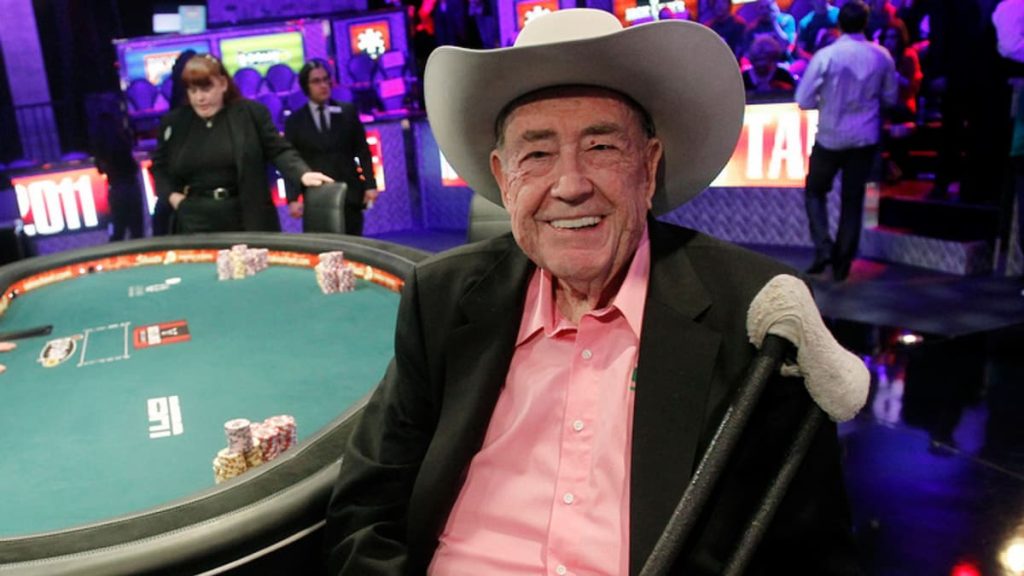
Few figures in poker history have cast a larger shadow over the game than Doyle Brunson.
A two-time World Series of Poker Main Event champion, 10-time bracelet winner, cash game pioneer, and author of the legendary Super/System, Brunson helped shape modern poker over a career spanning more than six decades. By the time he arrived in London in 2010 to promote his online gambling ventures, he was already regarded as poker royalty.
For one poker journalist, however, the interview would prove memorable for reasons few would expect.
First Impressions Of Texas Dolly
When Brunson arrived at the London gambling expo, there was no mistaking his presence.
Many poker fans knew him as the smiling elder statesman of the game. The grandfatherly figure in a cowboy hat who always seemed ready with a story or a joke during television appearances.
The reality that day felt rather different.
According to poker writer and editor Paul Saunders, Brunson came across as “a mix of grandfather figure, grumpy old man, and scary old-school poker player who’d seen it all.”
That reputation was well earned.
Brunson’s poker career began in an era of road gambling, underground card games, armed robberies, and long drives across Texas in search of action. He had survived health scares, business ventures, poker booms, and busts. By 2010, there was little left in poker that could surprise him.
Earning An Audience With A Legend
The setting itself was surprisingly quiet. Brunson was promoting a recently launched online casino that operated alongside Doyle’s Room, his online poker site. A small entourage surrounded him, and permission was required before any interview could take place.
Once Saunders introduced himself and explained where he had previously worked, Brunson recognized his name from his earlier work at PokerNews.com. The interview was approved. That was the easy part.
“The first 25 minutes were probably the hardest interview I’ve ever done,” Saunders recalled.
Brunson appeared tired and largely uninterested in discussing the casino business he had travelled to London to promote.
“It felt like a chore for him to be there,” Saunders said. “He seemed fed up with the casino side of things. The moment poker came up, though, he became much more engaged.”
Doyle Brunson’s Most Popular Videos
A Man Who Still Loved Poker
As the interview progressed, a pattern became clear.
Questions about the online casino generated short, functional answers. Questions about poker generated something entirely different. The legendary competitor suddenly became more alert. His answers grew longer. The conversation became more natural.
Saunders believes Brunson gradually realized he wasn’t speaking to another gambling industry reporter looking for promotional soundbites.
Instead, he was talking to somebody who had played the game and genuinely cared about poker itself.
“It took almost the whole interview to get him to smile,” Saunders remembered. “Once he realized I was interested in poker rather than just the casino business, he started to warm up.”
The difference was unmistakable. Behind the stern exterior remained the same passion for poker that had carried Brunson through six decades at the highest levels of the game.
Advice From One Of The Greatest
One answer from the interview has stayed with Saunders ever since.
Asked what advice he would give players hoping to make a living from poker, Brunson offered a response that perfectly reflected his practical approach to the game.
“Find your angle. Find the softest games and stick with them.”
It was classic Doyle.
No complicated theory. No grand speeches. Simply identify where you have an edge and exploit it.
Too many players, Brunson explained, believe they can beat everyone and every game. The smart professionals understand where their advantage lies and focus relentlessly on those opportunities.
More than 15 years later, in an era dominated by solvers, training sites, and advanced software, the advice still feels remarkably relevant.
The Side Of Doyle Few Fans Saw
One of the biggest surprises came when the conversation turned toward family. For all the toughness he projected, Brunson spoke warmly and proudly about those closest to him. It was one of the few moments where the intimidating poker legend seemed to fade into the background.
For a brief period, he wasn’t Texas Dolly.
He was simply a husband, father, and grandfather talking about the people he loved.
That human side stood in sharp contrast to the hard-nosed competitor who had spent decades battling in the biggest games in the world.
Looking Back
Doyle Brunson passed away in 2023 at the age of 89, closing the chapter on one of poker’s most extraordinary lives.
Looking back on their meeting, Saunders remembers a side of Brunson that many fans never witnessed.
The famous television smile wasn’t immediately present. Neither was the easy-going charm viewers had grown accustomed to seeing on screen. Instead, there was a tired veteran who appeared far more interested in talking poker than promoting an online casino.
Yet beneath that exterior remained the qualities that made him one of the game’s most respected figures: authenticity, honesty, and an enduring love for poker.
“It wasn’t really the Doyle people saw on television,” Saunders reflected. “At least not at first. But once the conversation moved away from online casinos and onto poker, family, and the game itself, he became a different person.”
For a journalist with more than two decades in poker media, the interview, now lost on a long-dead website, remains unforgettable.
Not because it was easy. Because it wasn’t.