Four people have been arrested and more than $118,000 seized following a police raid on 101 Poker Club in Katy, Texas. Officers entered the Houston-area cardroom on Thursday, October 22, with guns drawn, bringing the cash games to an abrupt halt.
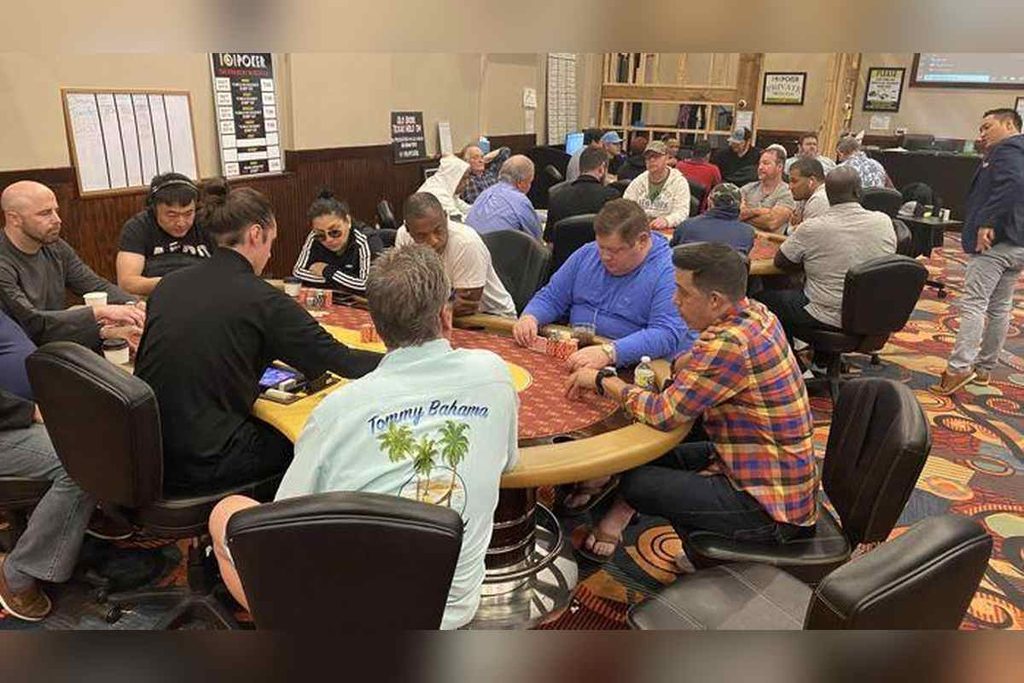
The club was back dealing within 24 hours, but the arrests have raised fresh questions about how poker rooms operate in Texas. Investigators have not publicly established what specific conduct triggered the raid, although allegations that the club took rake directly from pots have put its business model under scrutiny.
Four Arrested as Police Enter Busy Cardroom
Houston Police Department officers arrived at approximately 11:30 a.m., interrupting games at a venue known for its No-Limit Hold’em and Pot-Limit Omaha action.
Players were reportedly allowed to leave, while dealers and other staff were detained during the operation. Photographs subsequently released by police showed cash, poker chips and a money-counting machine.
On October 24, Houston police confirmed that the department’s Vice Division and the Harris County District Attorney’s Office had seized more than $118,000.
Four people were arrested:
- Stephen Hohman
- Brian Keegan
- Laura Respondek
- Randolph Reynolds
Police described the arrests as involving suspects “charged with engaging in organized criminal activity”. Charges were also reported as pending against a fifth, unnamed person. The precise allegations against each individual have not been independently established from court documents. An arrest or criminal charge does not establish guilt.
Was Rake the Problem at 101 Poker Club?
For anyone who regularly plays live cash games, rake is hardly an unfamiliar concept. The dealer pushes the pot, a few chips go into the drop box, and the house takes its cut.
In Texas, that routine transaction can create a serious legal problem.
The state’s poker rooms generally operate as private membership clubs, charging players to access the room or rent a seat rather than taking a percentage of each pot. The arrangement attempts to work within the private-gambling defenses contained in Texas Penal Code Chapter 47.
According to sources who spoke to PokerNews, 101 Poker Club charged membership fees but also allegedly removed chips from cash-game pots. That account remains an unproven allegation, and police have not confirmed that pot-raking was the reason for the operation.
How Much Can Each Charging Model Generate?
Consider an eight-handed cash game running for six hours. The following examples are illustrative, not reported charges at 101 Poker Club.
| Charging method | Example charge | House revenue over six hours |
|---|---|---|
| Hourly seat fees | $13 per player per hour | $624 |
| Pot rake | $5 from 25 pots per hour | $750 |
| Pot rake | $7 from 25 pots per hour | $1,050 |
A $5 drop might not sound particularly expensive when someone is dragging a decent pot. Across a busy cash game, however, those small amounts add up quickly. For the players, both methods eat into their expected hourly win rate. The legal questions are different because taking money directly from pots may undermine the private-gambling defenses on which Texas clubs rely.
Charging an hourly fee does not automatically make a poker room legal, either. Its membership rules, access arrangements and overall business model can still face scrutiny.
Our recent examination of the CoinPoker rake controversy looked at how higher charges affect winning players online. Texas adds another problem: how the money is collected can affect whether the room’s operation attracts criminal enforcement.
What Texas Gambling Law Actually Says
Texas Penal Code Section 47.02 provides a defense to gambling prosecution when three conditions are met:
- The gambling takes place in a private location.
- Nobody receives an economic benefit other than their personal winnings.
- All participants face the same chances of winning or losing, apart from differences in skill or luck.
Section 47.04 provides a related affirmative defense concerning keeping a gambling place. Other provisions address gambling promotion and organized criminal activity. One important point is that Texas law does not simply declare poker legal whenever a club calls itself private.
Whether the arrangements genuinely satisfy the statutory conditions is the issue. Prosecutors can challenge those arrangements, and operators can contest the allegations.
The organized-criminal-activity allegation is also more serious than a player simply sitting in a cash game. Section 71.02 allows certain Class A misdemeanor gambling offenses to form the basis of an organized-criminal-activity prosecution if the additional statutory requirements are established.
Another Texas Poker Raid in 2026
The 101 Poker Club operation follows a difficult year for Texas cardrooms, including the highly publicized investigation into The Lodge Card Club.
| Date | Development |
|---|---|
| March 10, 2026 | Authorities raid The Lodge Card Club in Round Rock |
| April 28, 2026 | A Williamson County grand jury declines to indict in the Lodge investigation |
| May 26, 2026 | The Lodge reopens |
| October 22, 2026 | Houston police raid 101 Poker Club |
| October 24, 2026 | Police confirm four arrests and the seizure of more than $118,000 |
Poker personality Doug Polk, who retains an ownership stake in The Lodge, stepped away from active management earlier this year. The room subsequently returned to hosting major tournaments, including the WPT Prime Championship, where freeroll qualifier Shrikant Pillamarapu won a six-figure prize.
The Lodge investigation and the 101 Poker Club raid are separate cases, handled in different counties. Nothing about the outcome at The Lodge establishes what will happen in Katy.
What Happens to Players’ Money After a Poker Raid?
A live poker room needs enough cash available to redeem chips, pay tournament prizes and manage daily transactions. Money found on the premises is not necessarily all operating profit, and the total seized does not establish how much came from allegedly unlawful activity.
As of October 25, the public reporting has not provided a breakdown of the $118,000 seizure identifying operating funds, player-related balances or other assets.
That leaves several practical questions unanswered:
- Were any outstanding player balances affected?
- Did the seizure include cash held against chips in circulation?
- Has the club provided written assurances about withdrawals and cash-outs?
- Will prosecutors seek to retain the seized funds?
For regular players, those questions are more immediate than the legal argument over membership fees.
101 Poker Club Reopens, but the Case Continues
101 Poker Club was reportedly operating again less than a day after officers entered the building. That is an unusually quick return following an operation involving arrests and a six-figure seizure, but reopening does not mean the investigation has been dropped or the accusations dismissed.
For Texas cash-game regulars, the concern extends beyond one club. The state has developed a substantial live poker scene without resolving the legal uncertainty surrounding commercial membership rooms. Players want somewhere to sit down, buy chips and get a game. Operators want to keep the tables running and the lights on.
Until Texas draws a clearer legal line, everybody involved in those games is operating with an uncomfortable amount of uncertainty.