Texas poker has spent the last few years proving that it can fill a card room, but the latest World Series of Poker Circuit stop in Austin has pushed that point a little further.
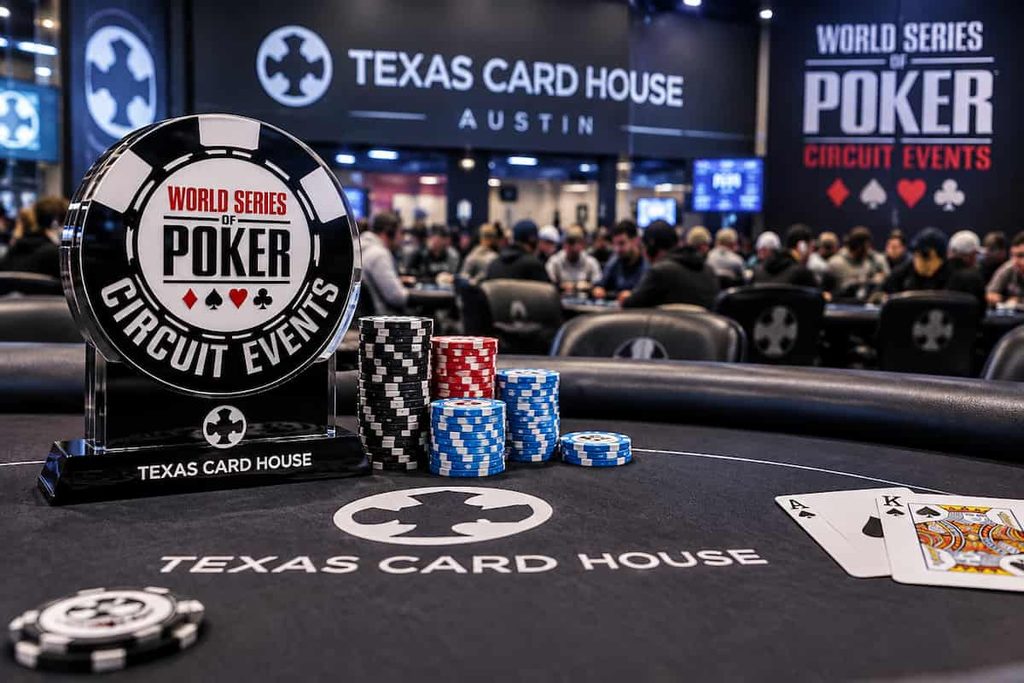
The $1,700 Main Event at Texas Card House has become the biggest WSOP Circuit Main Event ever, breaking a record only months after the same venue set a new benchmark for poker in the Lone Star State.
The record was confirmed after the third and final starting flight finished on Saturday night. PokerOrg’s live coverage described the tournament as the biggest WSOP Circuit Main Event of all time, while 150 players reached the money and the final 126 survivors from Day 1C joined the qualifiers from the first two flights for Sunday’s Day 2.
Texas Poker Keeps Finding Another Gear
There was already plenty of evidence that the Circuit had found a sweet spot in Austin. When the WSOP Circuit first visited Texas Card House earlier in 2026, the $1,700 Main Event attracted 1,709 entries and generated a $2,589,135 prize pool, smashing its $1 million guarantee. Local player Thomas “Trey” Brabham won that tournament for $368,545 and a second career Circuit ring.
Organisers responded in the most Texas way possible: they doubled the guarantee. The September Main Event came with $2 million guaranteed and three starting flights from September 17-19, part of an 18-ring festival running through September 21. Rather than cooling off after the novelty of the first visit, the turnout has now produced another Circuit record.
That makes Austin part of a wider run of huge numbers for the WSOP Circuit in 2026. Poker Type recently reported on the record-breaking WSOP Super Circuit Canada, where the Main Event drew 2,844 entries and the full festival awarded more than C$24.5 million. The Circuit has also been expanding internationally, with Liechtenstein beating its Main Event guarantee and a Panama return already confirmed for November.
Sein-Lwin Leads a Deep Day 2 Field
Derek Sein-Lwin will begin Day 2 with the overall chip lead after bagging 1,136,000. Emmanuel Ignacio came closest to catching him on the final flight, finishing Day 1C with 1,090,000, while Randall Campbell ended the night with 1,056,000.
There are plenty of familiar names still in the hunt. Defending champion Brabham advanced with 543,000, keeping alive the possibility of an unlikely back-to-back Main Event win. Andrew Moreno bagged 491,000, David Pham 601,000, Mukul Pahuja 354,000 and Timothy Miles 344,000, while Sami Bechahed returns with 687,000.
The bubble also burst before the end of the final flight. Andrew Moss became the official bubble player after several eliminations occurred almost simultaneously, meaning the remaining 150 players were guaranteed a payout before play continued toward the Day 2 redraw.
A Record With More Numbers Still to Come
The final payout table had not yet been released when the starting flights ended. PokerOrg said the payouts for the record-setting Main Event would be available before Day 2, so the exact first prize and full distribution will add another layer to the story once tournament staff publish the figures.
What is already clear is that Texas Card House has turned its Circuit stop into one of the tour’s heavyweight destinations. The first visit produced the biggest poker prize pool in Texas history. The return has now produced the biggest Main Event in WSOP Circuit history, which is a fairly convincing answer to anyone wondering if the spring turnout was a one-off.
Day 2 begins Sunday at noon local time, with the tournament scheduled to play toward Monday’s conclusion and a livestreamed final table. Every ring winner at the festival also receives a $5,000 WSOP Paradise package, so the eventual Main Event champion will leave Austin with more than the prize money and jewellery.
Why the Austin Record Matters
The Circuit’s appeal has always been its accessibility compared with the summer WSOP in Las Vegas. A $1,700 Main Event is still serious money, but it sits in a range where strong local grinders, travelling professionals and ambitious recreational players can realistically share the same field. When those events start producing fields of this scale, the distinction between a regional Circuit stop and a major poker festival becomes increasingly blurry.
Texas also remains an unusual poker market. Card rooms operate through membership and social-club models rather than conventional casino poker rooms, yet the demand for live tournament poker is plainly there. Two huge WSOP Circuit Main Events in the same Austin room within a matter of months suggest the market is not simply surviving under that structure. At the tournament tables, it is booming.