Online poker has become remarkably good at collecting information about its players. Every hand creates a trail of bets, timings, opponents and results that can be analysed for patterns no human observer would ever spot at the table.
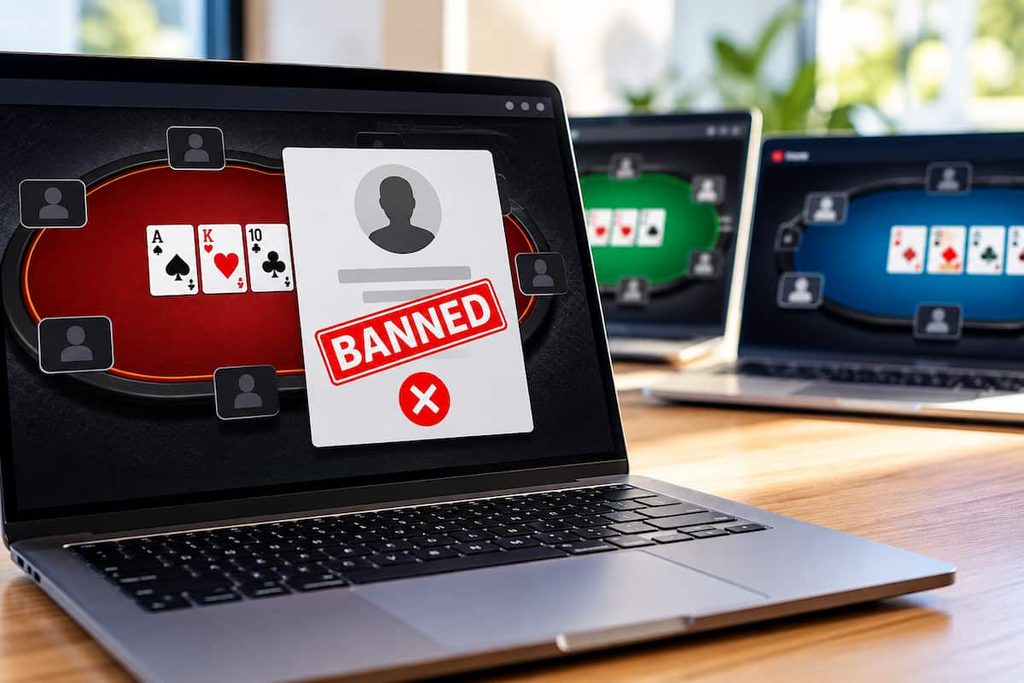
The problem begins when that trail leads an operator to the conclusion that somebody has cheated. A poker site can close an account, confiscate funds and refund opponents, but the decision usually remains inside that operator’s ecosystem. The same person may still be able to sit down elsewhere.
The recent Jurojin and Mesh Agent scandal has dragged that weakness back into view. Jurojin says a targeted attacker compromised update packages distributed to selected high-stakes players between June 2025 and January 2026, with some malicious packages installing remote-access software capable of exposing what was happening on victims’ computers.
Public reporting around the case has also raised a much wider question. If one poker room already considers a player dangerous enough to remove, when should another poker room be told?
A Ban Does Not Automatically Follow You
An online poker ban can sound more universal than it really is. If Poker Room A determines that an account has used a bot, colluded, received real-time assistance or broken another integrity rule, it can punish that account under its own terms. Unless the sites operate on the same network or have an information-sharing arrangement, Poker Room B does not automatically inherit that decision.
That matters because the serious forms of online poker cheating are rarely specific to one brand. A player willing to use real-time assistance on one site does not suddenly become trustworthy because the logo on the poker table changes.
The same applies to sophisticated collusion, multi-accounting, ghosting and malware-assisted cheating. These are methods, not site-specific behaviours.
PokerStars, for example, prohibits collusion, bots, tools offering real-time advice, sharing hole-card information and several other forms of unfair assistance. GGPoker has its own Security and Ecology Policy covering behaviour including multi-accounting, chip dumping, prohibited software, circumvention and other integrity breaches. PokerStars
The definitions overlap heavily, but the investigations remain separate.
The Jurojin Case Underlines This
The current malware allegations provide an unusually stark example because the alleged advantage could potentially have travelled across poker rooms.
Jurojin says the attacker targeted specific opponents and sought the ability to view their hole cards remotely. The poker sites themselves were not necessarily compromised because the weakness was introduced through third-party software running on the player’s computer.
According to reporting around the investigation, an account was previously banned by CoinPoker and more than $100,000 was confiscated and redistributed. Other accounts and activity later became the subject of scrutiny elsewhere, although allegations surrounding individuals remain subject to ongoing investigation and should not be treated as criminal findings.
That distinction is important. A site closing an account is not the same thing as a court convicting someone of fraud, and another operator should not simply copy a rival’s decision without reviewing evidence.
But the opposite extreme makes little sense either.
If one security team has identified compelling evidence of a serious integrity threat, starting from zero at every other poker room potentially gives the suspected cheater another opportunity to play while everyone repeats the same investigation.
Why Not Just Build a Poker Blacklist?
At first glance, the solution seems ridiculously simple.
Create one database. When a site catches someone cheating, add the player’s identity to it. Every participating poker room checks new accounts against the database and refuses access to anyone on the list. Unfortunately, that system creates almost as many questions as it answers.
What level of proof is required before somebody goes onto the list? Does a suspicious statistical pattern qualify, or does the operator need evidence of the software or method involved?
What happens when the evidence is strong enough for one room but not another? Does a player receive a lifetime ban for using a prohibited tool once, or are different offences graded according to severity?
Then there is the most important question of all: who decides?
Operators are simultaneously investigator, prosecutor and judge when enforcing their own terms. That can work reasonably well inside their own platform because the player agreed to those rules before playing.
An industry-wide sanction would be different. One company’s decision could affect a person’s ability to play poker across multiple businesses and possibly at live events too. That requires a much higher standard of governance.
GDPR Is a Problem, but Not the Excuse It Sometimes Becomes
Privacy law is often raised whenever poker players suggest sites should exchange information about cheats.
The reality is more complicated than simply saying GDPR prevents it.
UK guidance from the Information Commissioner’s Office explicitly discusses sharing personal information for preventing and investigating scams and fraud. Organisations still need an appropriate lawful basis, and data sharing must be necessary, proportionate, accurate and properly protected, but the law does not create a blanket ban on exchanging information designed to prevent harm.
The distinction between cheating and criminal conduct also matters. Someone breaching a poker site’s rules is not automatically committing a criminal offence, while allegations of criminal activity receive additional protection under data law.
That is one reason a professionally designed poker integrity system would probably be better built around confirmed breaches of agreed industry rules rather than casually labelling people criminals.
GGPoker‘s own European terms illustrate that information sharing is already possible in some circumstances. They state that the operator may inform other online gaming or gambling operators about a player’s identity and suspected unlawful, fraudulent or improper activity.
So the barrier is not simply that poker rooms are forbidden from talking to one another. The harder questions are what they share, when they share it, who receives it and what happens next.
Poker Has Already Tried an Industry Blacklist
There is another reason this debate cannot start from the assumption that nobody has considered it before.
GGPoker launched its Poker Integrity Council in 2022 with prominent professional players including Jason Koon, Andrew Lichtenberger, Fedor Holz, Seth Davies and Nick Petrangelo involved in reviewing serious cases. GGPoker said at launch that the most serious offenders could be placed on an industry blacklist.

Jason Koon
The council also partnered with major live poker organisations and venues, including the WSOP, WPT, Triton Poker and Asian Poker Tour. A player placed on the blacklist could therefore face consequences beyond GGPoker itself.
GGPoker’s current Security and Ecology Policy still states that integrity violations may be reported to the Poker Integrity Council. It also allows permanent network bans and confiscation of funds following confirmed breaches.
What the system has not become is a universal exchange through which all major online poker operators automatically feed their investigations.
That difference is enormous.
A blacklist beginning with cases discovered by one operator is not the same thing as an independent integrity network accepting intelligence from competing poker rooms.
There Is Also the Problem of Being Wrong
Poker players love databases because poker produces so much data. The danger comes when statistical evidence is treated as certainty.
An extraordinarily unusual win rate can trigger an investigation, but it does not identify how the result was achieved. Collusion, hole-card access, real-time assistance, account sharing and simple statistical variance can produce very different cases requiring different evidence.
That is why a shared system could not work as a giant spreadsheet titled “Cheaters.”
PokerStars has previously described an investigation process in which two investigators independently assess suspected cheating cases, with a third reviewer used when they disagree. That type of safeguard becomes even more important when a decision could eventually affect access to multiple poker rooms.
There also needs to be a route back.
GGPoker itself introduced an Olive Branch initiative in 2025 allowing certain previously banned players to seek reinstatement and providing another review route for players who believe they were wrongly accused. That acknowledges something any industry system would have to accept: integrity decisions must be reviewable.
Sharing Detection Methods Could Help the Cheaters
There is another reason operators might hesitate to cooperate too openly.
Poker security is an arms race.
If a room explains exactly which statistics triggered a bot investigation, a bot developer can adjust those statistics. If it reveals precisely how it detects remote-access software, an attacker can attempt to hide from that detection. This creates an important distinction between sharing a result and sharing the method used to reach it.
Poker Room A does not necessarily need to give Poker Room B its complete anti-cheating system. It may only need to provide enough independently reviewable evidence for Room B to decide that closer scrutiny is justified.
That would preserve valuable security techniques while still allowing intelligence to travel.
Sports Betting Already Has a Model Poker Could Study
Poker does not even have to invent the concept from scratch. The International Betting Integrity Association operates a monitoring network involving more than 90 operators and 200 betting brands. Its members contribute information to a system designed to identify suspicious betting activity and share alerts with operators, regulators and sporting bodies.
That is not directly transferable to poker. Detecting suspicious betting around a football match is different from determining that an individual poker player used prohibited assistance. The important idea is the structure.
Competitors can cooperate on integrity without handing one another their entire businesses. An independent poker equivalent could receive alerts, look for matches across operators and escalate cases when multiple independent signals point towards the same player or group.
What a Real Poker Integrity Network Could Look Like
The strongest system would probably avoid an immediate industry-wide ban whenever one operator raises a concern. It could instead use several evidence levels, with increasingly serious consequences as independent information accumulates.
A workable framework could include:
- Confidential alerts linked to verified player identities rather than screen names.
- Agreed definitions for bots, RTA, collusion, ghosting and other serious offences.
- Evidence thresholds separating suspicion from a confirmed integrity breach.
- Independent review before an industry-wide sanction is applied.
- An appeals process and periodic review of long-term bans.
- Strict limits on what information operators receive about detection technology.
The crucial part would be identity.
A cheater can change a screen name in seconds. An integrity network built only around usernames would be almost worthless.
Operators already conduct identity checks in regulated markets. An independent system could potentially match verified identities behind the scenes without publishing a searchable public list of names. That would be far more useful than a public wall of shame and considerably safer for players who have been wrongly accused.
Regulation Currently Stops at the Operator’s Door
The UK’s gambling rules demonstrate the current gap particularly well.
The Gambling Commission‘s technical standards require peer-to-peer gambling operators to implement measures designed to prevent and detect collusion and cheating. Operators should retain records that allow investigations, including player details, financial information, game activity and evidence associated with accounts that are closed following integrity investigations.
The rules also require systems capable of suspending or disabling accounts and state that complaints about suspected cheating should be investigated. What they do not create is a central poker integrity register.
One licensed operator can therefore build an excellent investigation file and remove a player from its games while another operator may know nothing about it. That is the hole an industry solution needs to fill.
A Ban Should Be the Beginning of the Conversation
None of this means Poker Room B should automatically accept Poker Room A’s verdict.
Competition between operators is healthy, independent investigations are necessary, and players need protection from incorrect accusations. A universal blacklist with no appeals process would be an ugly solution to a genuine problem. But complete isolation is not much better.
When an operator has strong evidence that somebody has deliberately compromised the integrity of peer-to-peer poker, there should be a secure mechanism for that information to reach other businesses exposing players to the same person.
The Jurojin case has shown how modern cheating can cross boundaries that traditional poker security was built around. The poker client itself does not even have to be compromised when an attacker can target the computers surrounding it.
Poker has spent years improving its ability to catch cheats. The next challenge is making sure that getting caught at one poker site does not simply mean opening an account somewhere else.