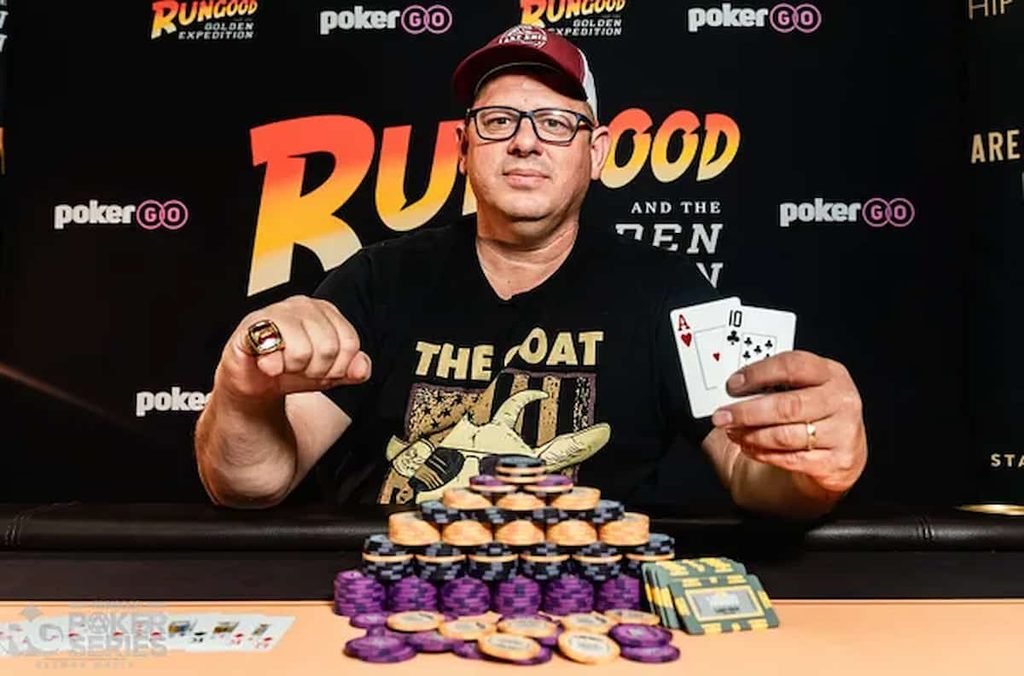
Michael Barlow won the RGPS Lake Erie Main Event with a payday just $2 larger than either of his final two opponents. A three-way deal settled the money before an unusual nine-card flip decided who took home the ring.
The $600 tournament attracted 360 entries and produced a $200,000 prize pool. Barlow collected $29,318, while Antonio Ndoja and David Hanna each received $29,316, turning a tournament with a scheduled $40,875 first prize into an almost equal financial finish.
The Shortest Stack Takes the Deal
Barlow told PokerNews he was last in chips when the agreement was reached. His explanation was straightforward: “I was last in chips, and they were giving me even money.”
That is the important decision behind the unusual ending. The player with the fewest chips secured approximately one-third of the remaining money, removing the risk of finishing third for a smaller scheduled payout.
An equal split gives each player the same share regardless of stack size. A deal based on chips instead allocates money using the stacks, so the shortest player normally receives less than the leader under that approach.
Equal money therefore offers something particularly attractive to a short stack. It exchanges a difficult playing position for certainty, although the exact value of the concession depends on the stacks and the original payout structure.
Why Equal Money Is Not the Same as Equal Chances
A third of the chips and a third of the remaining prize money are different things. Tournament payouts reward finishing positions, while chips determine how much room a player has to survive, apply pressure and compete for those positions.
The Independent Chip Model approach estimates stack values against the available payouts. It accounts for the fact that each surviving player already has a minimum prize secured, rather than treating every chip as having a fixed cash value.
That gives players a useful starting point for negotiations, but it does not force an agreement. An equal split, chip-based deal or ICM calculation remains an offer that everyone involved must accept under the tournament’s rules.
Barlow’s comment explains his own reason for accepting. It does not establish that the other players made a mistake, because a deal also reflects their willingness to keep playing for a larger but uncertain return.
A Nine-Card Flip for the RGPS Ring
With the financial agreement in place, Barlow and Ndoja entered the flip for the ring; Hanna did not participate. Each received nine cards alongside a five-card community board, with Barlow’s tens full of aces beating Ndoja’s tens full of jacks.
That was an agreed way to settle the title, rather than a standard Texas Hold’em heads-up contest. The money decision and the trophy decision had effectively become separate parts of the tournament’s conclusion.
Ndoja told PokerNews: “I didn’t want to leave ten grand up to chance.” His remark captures the appeal of stopping the financial contest before another run of cards changes who gets the largest cheque.
For spectators, the flip supplies the memorable image. For players, the preceding negotiation is the more useful part to understand, because accepting a deal changes what remains at risk in every subsequent hand.
RGPS Lake Erie Main Event: The Three-Way Deal
| Recorded finish | Player | Payout |
|---|---|---|
| 1 | Michael Barlow | $29,318 |
| 2 | Antonio Ndoja | $29,316 |
| 3 | David Hanna | $29,316 |
The listed prizes total $87,950. Barlow received fractionally more than an exact third, while the other two received fractionally less, leaving only a $2 difference between the champion and each of his fellow deal-makers.
The recorded finishing order therefore needs context. It tells readers who received the title, but the accompanying payouts show that the final three had already reached almost the same financial outcome.
What Players Should Check Before Agreeing a Chop
The first question is which method produced the offer. Knowing the difference between an equal split and a stack-based calculation makes it easier to judge the amount, rather than accepting a number simply because negotiations have started.
Players should also establish what remains to be contested. Cash, a trophy, ranking points or a package can each give the remaining action value, and the tournament organiser’s deal policy determines which arrangements are permitted.
Finally, a headline prize is not the same thing as a player’s actual receipt after a deal. Nor is a tournament payout automatically profit, because entry costs and any staking arrangements sit outside the results table.
Barlow’s win shows how much a final-table agreement can change a result. Accepting the chop removed the remaining financial variance from the finish. Here, the ring separated the finalists far more sharply than the money did.