Matthew Wantman began the final day of the $26,000 PGT PLO Championship with roughly 12 big blinds and only one player below him in the chip counts. He finished third for $174,000, making his recovery one of the most revealing stories behind Cesar Garcia’s victory.
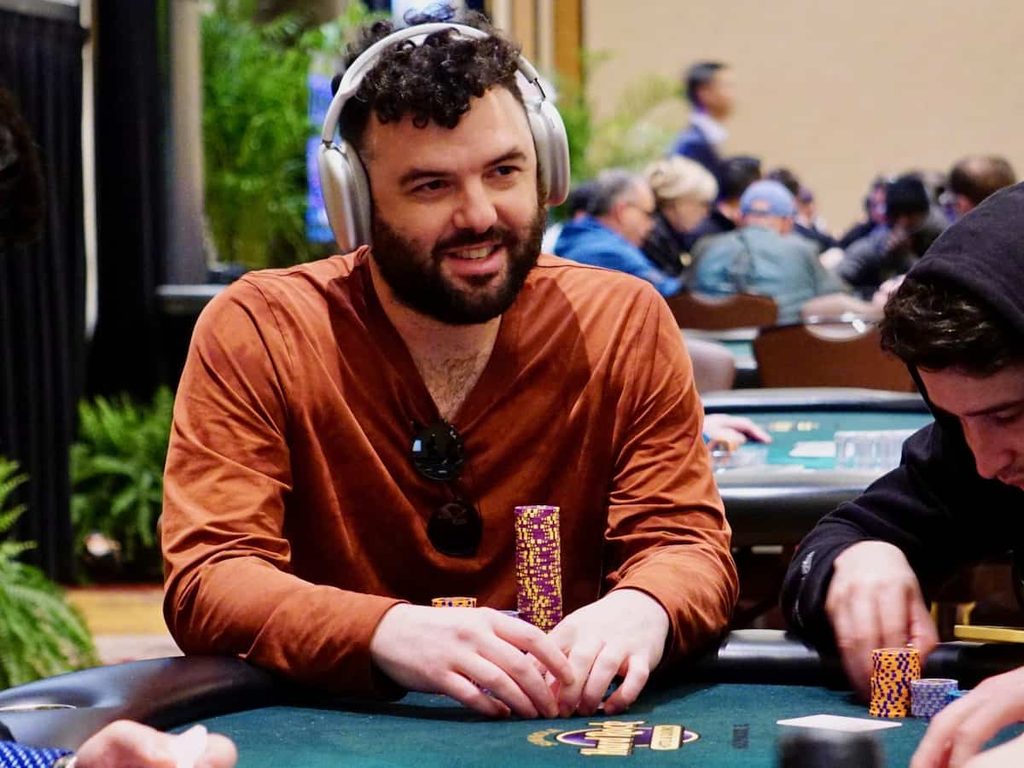
Wantman returned with 295,000 chips at blinds of 15,000/25,000, equivalent to 11.8 big blinds. Twelve players remained, only seven would be paid, and the smallest cash was $48,000.
Five Eliminations Away From Any Return
That starting position put him under two different kinds of pressure. He needed chips to keep playing, but the approaching money bubble also made each elimination elsewhere increasingly valuable.
The biggest mistake in reading a short stack’s tournament position is treating it as a finishing prediction. Chip counts describe a player’s resources at that moment, while the next pot, blind level and opponents’ decisions can change the order quickly.
With fewer than 12 big blinds, there is limited room to absorb losses. Position and effective stacks become especially important, because a pot that is routine for a leader can commit most of a shorter player’s tournament.
Survival alone is not a complete strategy, however. Folding every marginal decision also costs blinds and antes, so a player still needs to identify opportunities to contest pots rather than relying entirely on others to bust.
The Pay Ladder That Made Third Place Matter
Garcia won the championship for $420,000 and Robert Cowen finished second for $264,000. Wantman’s third-place payment was $126,000 above the minimum cash, showing how much value remained available after the bubble.
| Place | Player | Prize |
|---|---|---|
| 1 | Cesar Garcia | $420,000 |
| 2 | Robert Cowen | $264,000 |
| 3 | Matthew Wantman | $174,000 |
| 4 | Lautaro Guerra | $126,000 |
| 5 | Youness Barakat | $96,000 |
| 6 | Sean Rafael | $72,000 |
| 7 | Brevin Andreadis | $48,000 |
Those figures explain why reaching the money is only one stage of a tournament recovery. Every extra place can add substantial value, even when the player never becomes the overwhelming favourite to win.
They also help put third place in perspective. Missing the trophy does not make a deep run unsuccessful, especially for a player who began the day outside the paid positions with very little room for error.
Wantman was already familiar to Poker Type readers after his recent Triton breakthrough. This result adds a different kind of performance to that story: a climb through a PLO field from near the bottom of the returning chip counts.
A Seven-High Straight Meets a Flopped Full House
His decisive setback came in a limped pot between the blinds. Wantman called Garcia’s pot-sized river bet with a seven-high straight, but Garcia had flopped sevens full of fours; Wantman was left with two big blinds and exited shortly afterwards.
The contrast is useful for anyone moving from Hold’em to Omaha. A straight is a strong category of hand, but its strength in a particular pot depends on the board and on the stronger hands an opponent can hold.
On a paired board, full houses become possible. In PLO, each player has four hole cards, giving them more two-card combinations to connect with the community cards than a Hold’em player has.
Omaha still requires exactly two hole cards and exactly three board cards. Having four cards does not allow a player to use whichever number produces the most convenient five-card hand.
Why the River Price Matters
A full house beats a straight, but the strategic question is broader than which hand won this showdown. A caller must judge how their holding performs against the opponent’s possible value bets and bluffs.
Facing a pot-sized bet, a player must call one pot to contest a final pot of three times that amount. Ignoring tournament effects and assuming the call closes the action, they need to win about one-third of the time to break even.
That is a pricing calculation, not a verdict on Wantman’s call. Evaluating the decision would also require the complete action, suits, relevant blockers, effective stacks and a defensible estimate of Garcia’s betting range.
The revealed full house tells us why the call lost. It does not, by itself, tell us how frequently Garcia reaches that spot with weaker hands or whether a fold was clearly preferable before the cards were shown.
A Comeback Without the Trophy
A tournament report naturally gives the winner the largest headline. Looking at the returning stacks alongside the payout ladder reveals another measure of performance: how far a player moved from the position they actually faced.
Wantman’s run illustrates that distinction without needing an invented account of his thinking. The starting stack, unpaid position and third-place finish are enough to show how substantially his tournament changed.
For players studying their own deep runs, that is a more useful comparison than asking only who won. Review the decisions and opportunities that moved a stack forward, then examine the losing hand in its full context rather than allowing it to define the entire event.