At 100 years old, most people would be forgiven for choosing a quieter way to spend their time. Ivor Ward, however, is still calculating pot odds, studying opponents and competing in one of Britain’s biggest live poker tournaments.
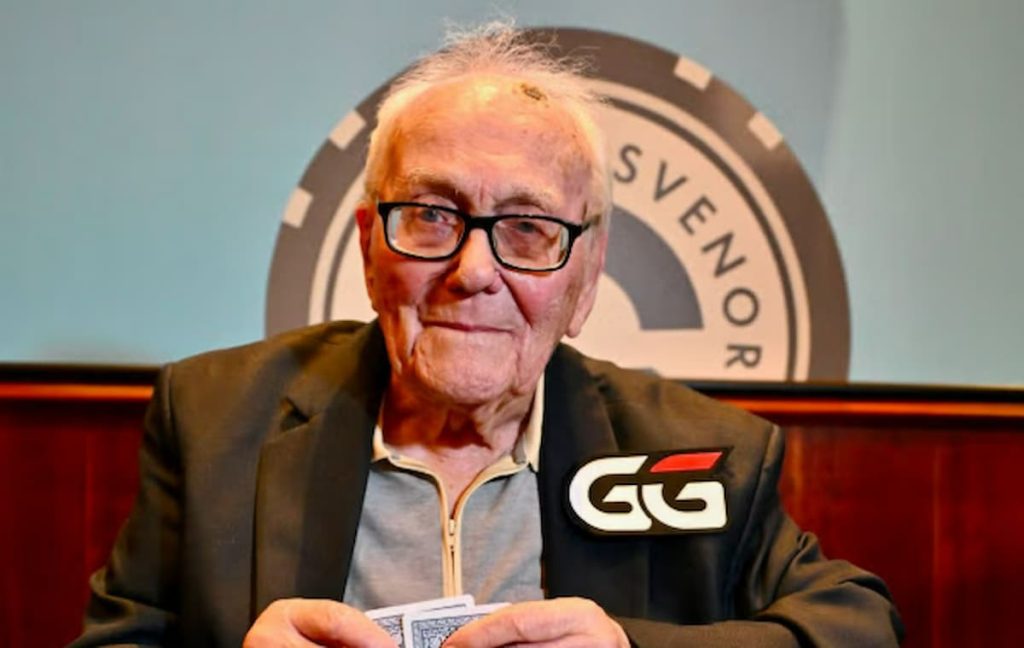
The centenarian recently took his seat in the opening flight of the 2026 Goliath at Grosvenor Casino Coventry, reportedly becoming the oldest player ever to enter the popular event.
Ward first learned poker as a 14-year-old in 1940. More than eight decades later, he remains fascinated by the strategy, mathematics and psychology behind the game.
His advice for winning at poker is surprisingly modern. His wider outlook on handling losses may be even more valuable.
Nearly Nine Decades of Poker Experience
Ward began playing cards with friends in a pub in Boston, Lincolnshire, long before online poker, training software or game theory entered the vocabulary of most players.
Poker has changed dramatically since then.
Today’s serious players study range charts, solver outputs, expected value calculations and vast databases of hands. Ward has not ignored those developments simply because he learned the game in a different era.
Although he accepts that he may be too old to rebuild his entire strategy, he continues to follow modern poker theory and has added newer concepts to his game.
“I like to keep in touch with other players,” Ward explained. “A lot of them are getting really technical, but I think it’s a good thing. It appeals to the next generation of players too.”
That willingness to keep learning may be one of the biggest lessons younger players can take from him.
Experience is valuable, but only when it does not become an excuse to stop adapting.
Ivor Ward’s Poker Tips
Asked what players need to consider at the table, Ward highlighted three familiar fundamentals:
- Percentages and odds
- Table position
- Studying opponents
“You’ve got to work out percentages, odds, studying your opponents,” he said. “These are all things to take into consideration.”
It is simple advice, but it covers much of what separates thoughtful poker from gambling blindly.
Understanding the odds helps players judge whether a call can be profitable. Position changes how many hands can be played and how much information is available. Observing opponents can reveal tendencies that are not captured by the cards alone.
Ward’s approach combines all three rather than relying entirely on mathematics or instinct.
Watch for Sudden Changes in Body Language
After 86 years around card tables, Ward believes he has become particularly skilled at noticing physical tells.
His advice is not to look for dramatic nervous movements or exaggerated reactions. Instead, he watches for small changes in posture and behaviour.
“Sometimes you’ll see someone sitting back, and they’ll suddenly sit forward,” he said. “You know their cards are very good because they’ve taken an interest.”
A single movement should never be treated as proof that someone has a strong hand. Players shift in their seats for countless reasons.
However, Ward’s observation reflects a useful live poker principle. Changes from a player’s normal behaviour are often more meaningful than the behaviour itself.
Someone who always leans forward is not revealing much. Someone who suddenly becomes alert after appearing uninterested may be providing information.
Can Poker Help Keep the Brain Active?
Ward believes poker has played a major role in keeping him mentally sharp.
The game requires players to remember previous action, calculate odds, assess risk, control emotions and pay attention to several opponents at once. It is also a social activity that gives people a reason to leave the house and interact with others.
Ward worked as a production operative at pharmaceutical company EM Pharma until he was 98, completing four shifts each week before eventually retiring.
He now encourages older people to consider playing friendly, low-stakes poker rather than becoming isolated after retirement.
“People retire and just sit at home,” he said. “They’re not going out, they’re not meeting people, they’re not using their brains. Poker allows them to be active.”
Poker should not be presented as a guaranteed route to a longer life. Ward’s personal experience nevertheless highlights several potentially positive elements of the game.
It offers mental stimulation, social contact and an activity that can continue long after many physical hobbies become difficult.
The stakes do not need to be high. For older or inexperienced players, a regular home game played for small amounts may provide the social and intellectual benefits without creating unnecessary financial pressure.
His Most Important Advice Is About Losing
Ward’s most memorable lesson has little to do with opening ranges or pot odds.
Every poker player experiences bad beats, failed bluffs and tournaments that end far earlier than expected. Strong players still lose sessions, and even statistically correct decisions can produce painful short-term results.
Ward’s response is to avoid carrying those disappointments into the next hand.
“If you’ve had a bad hand or you got beat, forget it,” he said. “The secret is to learn to live with your bad things and just wipe them out completely.”
That is effectively an old-school explanation of avoiding tilt.
Players cannot change the cards that have already been dealt. Becoming angry, distracted or desperate to recover a loss only makes the next decision more difficult.
Ward’s solution is straightforward: accept what happened, learn what you can and move on.
What Poker Players Can Learn From Ivor Ward
Ward’s longevity makes his story remarkable, but his approach to poker is not built on a mysterious secret system.
He studies the numbers. He pays attention to position. He observes his opponents. He remains open to new ideas and refuses to allow one bad result to affect the next decision.
Those principles apply to players of every age.
His appearance at the 2026 Goliath also demonstrates something that poker does unusually well. The same tournament can bring together professionals, recreational players, online qualifiers and a centenarian who first encountered the game during the Second World War.
Ward may not play the same way as the solver-trained generation surrounding him, but he shares their desire to understand the game and keep improving.
After 86 years of poker, he is still watching, calculating and learning.
That may be his most impressive achievement of all.