You’ve got 175,000 on the button and the blinds and ante add up to 5,000. Steal them and your day is done. Open and get shoved on by the one player who covers you, though, and you’ve got a decision worth considerably more than the blinds.
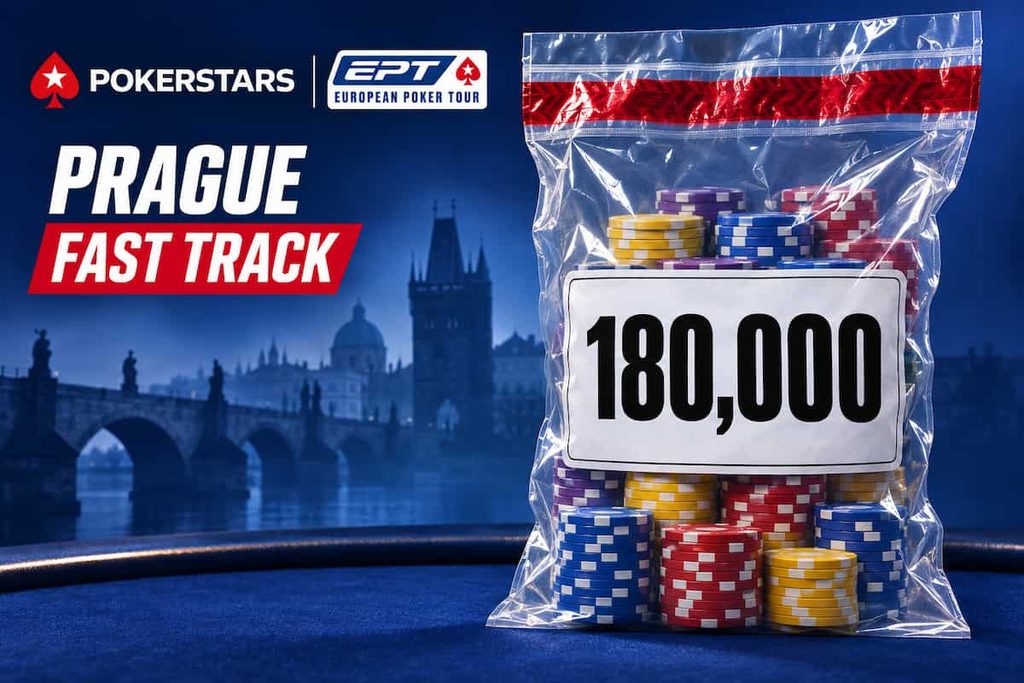
That’s the spot the EPT Prague Fast Track format sets up this December. In two no-limit hold’em side events, anyone who turns 30,000 into 180,000 on Day 1 bags their chips there and then. You’ve secured a cash and a seat on Day 2. Your table carries on without you.
Two buy-ins, the same 180,000 target
The €550 runs on the opening day of the festival. The €1,100 starts eight days later. Both allow unlimited re-entry during registration, so the first decision for anyone travelling to Prague is how many bullets they’re prepared to fire. All times below are local.
| Event | Day 1 | Registration closes | Final day |
|---|---|---|---|
| #4 · €550 Fast Track | Wed 2 Dec, 14:00 | 20:50 | Thu 3 Dec |
| #47 · €1,100 Fast Track | Thu 10 Dec, 14:00 | 20:30 | Fri 11 Dec |
The target is six starting stacks at either price. If you’ve played a milestone satellite, you’ll recognise the moment the floor comes over to count your chips. The difference comes the following day. There’s still a first prize to play for, and what you take through can matter.
What happens to the chips above 180,000?
We’ve already seen what that looks like. At the original €550 trial in Barcelona, most qualifiers bagged around the target, but Barry Carter reported that the overnight leader had 283,000. With play resuming at 2,000/4,000, that was just under 71 big blinds. A player who hit 180,000 on the nose came back with 45. That extra 26 big blinds is a decent reason to want a call when you’ve got the goods.
Barcelona drew 572 entries. Sacha Cohen won €52,000 and Maria Konnikova collected €32,500 for second. EPT tournament director Toby Stone summed up the appeal for PokerStars on Monday in rather more practical terms: “no tortuous bubble, finish early, go for dinner”. The catch for anyone used to nursing a short stack through the money bubble is that somebody busting two tables away adds precisely nothing to your stack.
You need 5,000. How much are you willing to risk?
Back to that button hand. Say the blinds are 1,000/2,000 with a 2,000 big blind ante. It folds to you with 175,000 and you open to 4,000. If both blinds pass, you finish with exactly 180,000. Now give the big blind 178,000 at the start of the hand and let them shove. Your open has cost you 4,000. Calling costs the other 171,000.
Folding leaves you with 171,000, still only 9,000 short. Calling and winning gets you a much bigger bag if Prague plays like Barcelona. Calling and losing sends you to the rail. A hand good enough to open for a steal can be an easy pass to that shove. Equally, if you opened aces and a player you know can jam light obliges, the target is a poor reason to talk yourself out of the call.
Change just one detail. The big blind starts the hand with 22,000 instead. With the small blind folded, the effective stack is now 22,000 before forced bets. Winning still gets you over the line. Losing still leaves you with more than 150,000. Same hole cards, same target, very different price for being wrong. Count the stacks behind you before you reach for opening chips.
Who wants to play the next pot?
Watch the player on 170,000 as closely as you watch the short stack. If that player starts passing good spots because they can see the finish line, opening into their blind gets more attractive. If they’ve worked out that picking off one steal might get them through, expect resistance. Position and the person in the seat still matter more than a tidy rule about playing tight near the money.
There’s a cost to waiting, too. At the blinds in our example, folding an entire orbit costs 5,000. Start that orbit needing one clean steal and you finish it needing two at the same level. The clock won’t bag your chips for you.
For more on how stacks and payouts pull decisions in different directions, see how Andy Black finished fourth in Glasgow and took the biggest payout. For players planning the next trip after Prague, Poker Type’s 2027 EPT schedule and Main Event buy-in guide covers all five stops.