Poker Type has launched a new interactive Poker DNA assessment designed to reveal how players naturally approach the game.
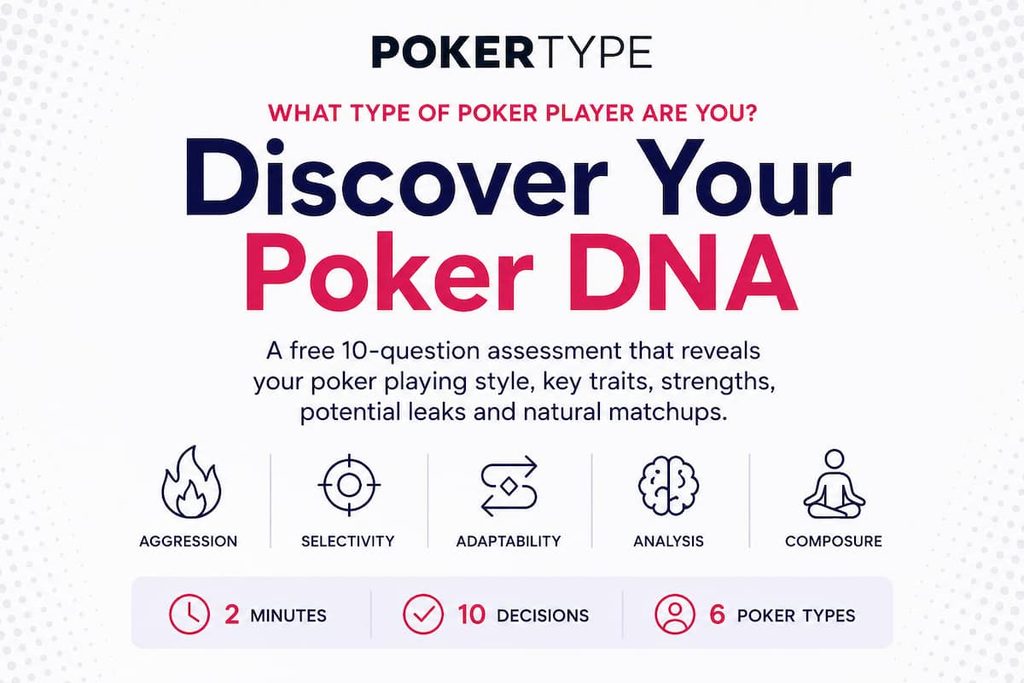
Available directly on the Poker Type Poker Tools page, the free assessment presents players with 10 poker decisions before building a personalised profile across five key traits: aggression, selectivity, adaptability, analysis and composure.
Rather than testing poker knowledge or asking players to solve hands with a single correct answer, Poker DNA focuses on tendencies. Each question presents a realistic poker situation and asks the player to choose the response closest to how they would naturally react.
The assessment takes around two minutes to complete.
Six Different Poker Types
Once all 10 questions have been answered, Poker DNA analyses the player’s responses and identifies a primary and secondary Poker Type.
There are six possible primary types:
- The Grinder
- The Pressure Player
- The Calculator
- The Exploiter
- The Trapper
- The Instinct Player
The classifications are designed to reflect recognisable approaches to poker without suggesting that one style is inherently better than another.
A Pressure Player, for example, is naturally inclined towards initiative, aggression and creating difficult decisions for opponents. A Calculator places greater emphasis on ranges, mathematics and structured reasoning, while an Exploiter is more likely to change strategy according to the tendencies of individual opponents.
The secondary type adds another layer to the result. Two players may both be classified as Pressure Players, for example, while one has the Exploiter as a secondary type and another is closer to the Calculator.
Your Five Poker DNA Traits
The result goes beyond assigning a player a label.
Each player receives an individual score for the five traits that make up their Poker DNA.
Aggression measures the tendency to create action through betting, raising and pressure rather than allowing opponents to dictate it.
Selectivity looks at how willing a player is to enter marginal situations compared with waiting for stronger or more clearly profitable opportunities.
Adaptability measures the extent to which opponent tendencies and changing table conditions influence strategy.
Analysis considers the balance between structured reasoning, ranges and mathematics and a more intuitive approach based on feel and situational judgement.
Composure looks at how consistently a player maintains their decision-making process when faced with losses, pressure or changing momentum.
Together, those scores create a more detailed picture than the primary Poker Type alone.
Strengths, Leaks and Difficult Matchups
Poker DNA also explains what the resulting profile could mean at the table.
Players receive an overview of their natural strengths alongside potential leaks associated with their style. The assessment also identifies the Poker Type they may be naturally equipped to play against and a potential “Poker Nemesis” whose tendencies could create more difficult situations for them.
A highly aggressive style can create considerable fold equity, for example, but may also produce unnecessary variance if pressure continues after the available information has changed.
A selective and patient player may avoid many marginal situations but risk surrendering too many uncontested pots to opponents willing to apply pressure.
The aim is not to tell players how well they play. Poker DNA instead provides a framework for thinking about how they make poker decisions.
What Type of Poker Player Are You?
Poker has traditionally used broad descriptions such as tight, loose, aggressive and passive to categorise playing styles. Modern poker is considerably more nuanced.
Players can be aggressive but highly analytical, selective but adaptable, or instinctive while still displaying strong composure. The combination of those tendencies can be more revealing than any single characteristic.
Poker DNA was built around that idea.
There are no deliberately “good” answers to select and no poker score to beat. The most useful result comes from choosing the response that most closely resembles what you would actually do at the table.
Take the Poker DNA Assessment. It’s a free tool from Poker Type, requires no signup, and takes approximately two minutes to complete.