The World Series of Poker has returned to ESPN, but the first television ratings show how much the way fans consume poker has changed.
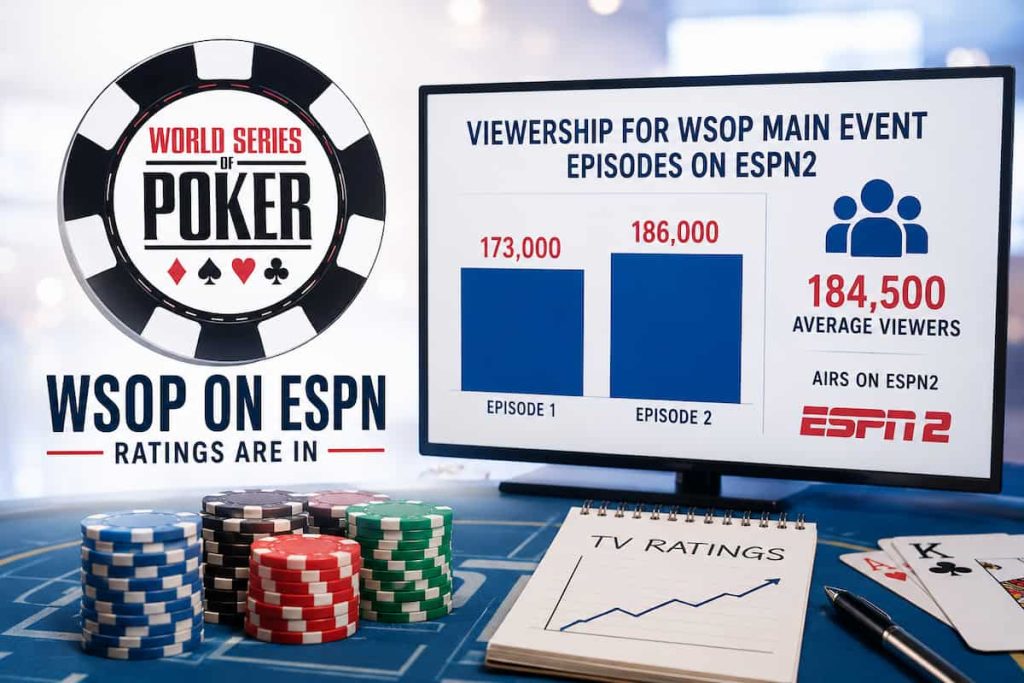
The opening two edited episodes of the 2026 WSOP Main Event attracted average audiences of approximately 173,000 and 186,000 viewers on ESPN2. Those numbers are modest compared with the million-plus audiences televised poker regularly attracted during its peak years.
However, they do not necessarily mean people have stopped watching TV poker.
Instead, the figures highlight a much bigger shift. Poker fans now have more ways to follow the game than ever before, and traditional cable television is no longer the only place they are looking.
How Many People Watched the WSOP on ESPN?
The first two documentary-style Main Event episodes aired back-to-back on ESPN2 on Tuesday, July 21st.
The opening hour averaged around 173,000 viewers, while the second increased slightly to approximately 186,000. The first episode recorded a 0.09 household rating, followed by 0.11 for the second hour.
Neither programme finished among the 100 most-watched cable shows across all audiences that evening, although the first episode performed better among adults aged 18 to 34.
At first glance, those numbers may appear disappointing for the return of poker’s biggest tournament to its former television home.
The wider context matters, though.
WSOP Faced a Crowded Night on Cable
The debut episodes were not shown in isolation.
They competed with live news, entertainment reruns and other sports programming. Poker.org noted that the WSOP coverage even finished behind TNT’s Dunkman World Championship, a professional basketball dunking competition.
ESPN also appears to have given the episodes limited promotion before their premiere. That makes it difficult to know how many casual sports fans were aware that the WSOP had returned.
The episodes were also edited recaps of a tournament that had already played down to its final nine. Many dedicated fans had followed the action live through streaming coverage, social media updates and poker news sites earlier in July.
That reduces the urgency to watch a condensed television version several weeks later.
How the Ratings Compare With Poker’s Boom Years
Poker’s relationship with ESPN helped turn the WSOP Main Event into a major television product during the 2000s.
Following Chris Moneymaker’s 2003 victory, Main Event episodes frequently attracted hundreds of thousands of viewers. By 2008, the first delayed Main Event final table drew approximately 2.4 million viewers, a 49% increase from the previous year.
The final night of the 2015 Main Event still averaged 1.15 million viewers on ESPN, while earlier final-table coverage that year attracted audiences ranging from 460,000 to 810,000.
Viewed against those figures, an audience below 200,000 looks small.
But direct comparisons are difficult because the television industry has changed dramatically.
Cable Television Is Much Smaller Than It Used to Be
During poker’s boom years, ESPN was available in tens of millions more American homes than it is today.
Poker.org reports that ESPN reached around 85 million homes in 2003 and later surpassed 100 million. By 2026, that figure had fallen to approximately 60 million households, representing a decline of around 30% since the beginning of the COVID period alone.
Cord-cutting has reduced audiences across cable television, not just poker.
At the same time, viewers have moved towards streaming services, YouTube, Twitch, social media clips and direct-to-consumer sports platforms. A fan who once had to wait for an ESPN episode can now watch hours of live tournament coverage, hand breakdowns and player interviews whenever they choose.
That makes television ratings only one part of poker’s overall audience.
Poker Has Become a Streaming Product
The 2026 WSOP coverage reflects this change.
ESPN agreed to provide more than 100 hours of Main Event coverage across its platforms, beginning with live action through the ESPN App. The cable episodes are only one part of a wider multiplatform package.
Poker fans can also follow major hands almost instantly through social media. Creators publish reactions and analysis before a traditional television episode reaches the air.
For committed followers, streaming provides more action with fewer edits. For newer viewers, short videos and creator-led content may be a more natural entry point than a scheduled programme on ESPN2.
This does not make television irrelevant. It simply means TV no longer carries the entire burden of introducing people to poker.
The Live WSOP Final Table Will Be the Real Test
The most meaningful ratings are still to come.
ESPN will show the 2026 WSOP Main Event final table live across three nights from August 3rd to August 5th, with coverage scheduled for the 9 p.m. to midnight Eastern Time window.
That broadcast has several advantages over the opening episodes.
It will be live, the world championship will be decided, and viewers will not already know the result. It also gives ESPN a clear event to promote rather than asking casual viewers to commit to an edited recap.
A strong final table could attract significantly more viewers and show that major live poker moments still have a place on traditional television.
Are the WSOP Ratings Actually Bad?
The honest answer is that they are low, but not necessarily alarming.
Fewer than 200,000 viewers would have been considered a poor result during poker’s ESPN peak. In today’s fragmented media environment, it represents only the visible cable audience and excludes many people watching through apps, clips and other digital coverage.
The bigger question is not whether poker can recreate its 2008 television ratings.
It is whether ESPN can use live broadcasts, streaming and edited storytelling together to introduce the WSOP to viewers who do not already follow the game.
Poker television may never again dominate cable in the way it did during the Moneymaker boom. Yet the continued growth of live events proves the audience has not disappeared.
It has simply moved.