Hustler Casino Live has suspended Britney Jing and Chengsi “C Ye” Ye after finding that Britney held a financial stake in Ye while they played at the same table. HCL’s review found no evidence that Britney cheated, colluded or soft-played the hands under investigation.
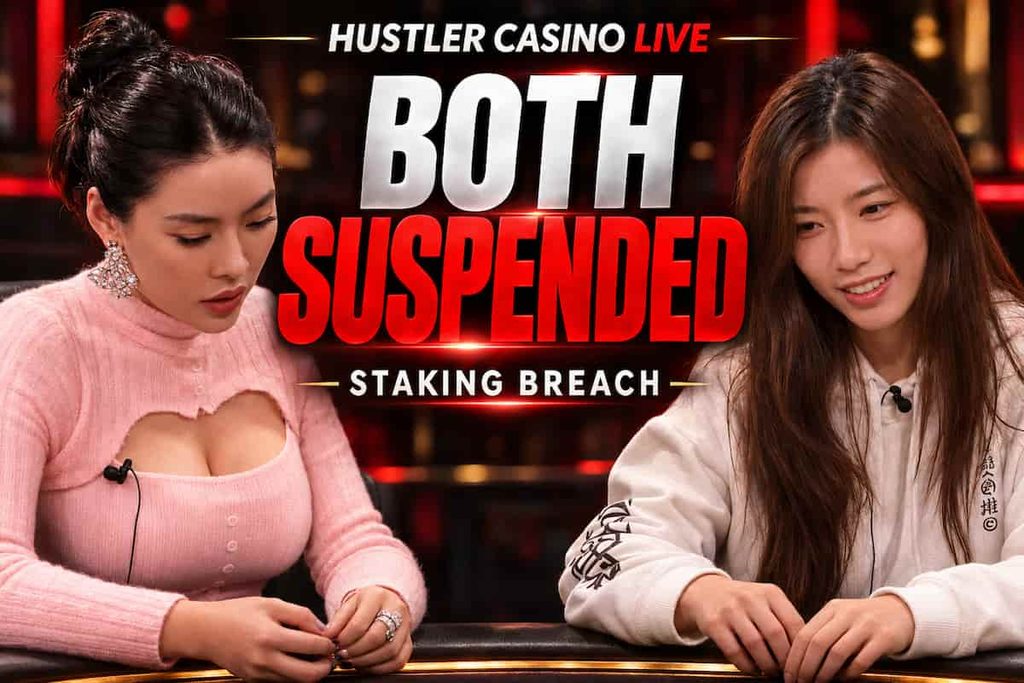
The show announced its findings on Monday 16 November, following the review that took Britney off its broadcasts in October. It has given no public end date for either player’s suspension. The decision puts a familiar cash-game question back in front of players: who at your table has a piece of somebody else?
What HCL’s Review Found
In its statement, reproduced by PokerNews, HCL said Britney “did not engage in cheating, collusion, or soft-playing at the table”. The show said she subsequently acknowledged holding a financial interest in C Ye during games in which they competed together, breaching its conflict-of-interest policy.
That finding belongs at the front of any account of the case. Viewers spent weeks arguing over individual hands, while the show reviewed footage and hand histories. HCL’s published conclusion clears Britney of the playing misconduct it examined and identifies the staking arrangement as the reason for the suspensions.
| Issue | Position after HCL’s announcement |
|---|---|
| Cheating, collusion and soft-playing | HCL said its review found no evidence involving Britney. |
| Financial interest at the same table | HCL said Britney acknowledged a stake in C Ye and that this breached its policy. |
| Stream appearances | Both players are suspended, with no public return date. |
| Earlier money dispute | The announcement provides no public settlement of the disputed $18,000. |
The $18,000 Dispute Behind the Review
The disagreement became public after C Ye alleged that Britney had failed to settle money owed under a 30% staking arrangement. Britney disputed owing the balance and published her own account and messages. Poker Type covered both sides in Britney’s response to C Ye’s $18,000 claim.
In that response, Britney wrote: “I have no outstanding debts, and I have always paid out my shares right away.” Her account challenged how the relationship ended and whether the disputed sum remained payable. Those competing accounts need to stay attributed to the players who made them.
HCL’s latest statement deals with eligibility to play on its broadcast. Anyone reading it for an answer about who ultimately owed whom $18,000 will still be looking. The practical update is that the investigation has finished and both players currently lose their seats on the stream.
Why Owning a Piece Changes the Economics
A staking agreement gives the backer an interest in another player’s results. At a table where that backer is also playing, the two seats can have financial connections that affect the rest of the line-up.
Take a simplified example. Player A owns 30% of Player B’s net result for a cash session. If B loses $10,000 directly to A, A wins $10,000 at the table but bears $3,000 of B’s loss through the staking agreement. A’s combined change is therefore $7,000, ignoring rake and other hands. Against an opponent with no such connection, the same $10,000 transfer has a different financial effect.
That arithmetic explains why a game might restrict those arrangements even when a review finds the hands were played honestly. Other players have an interest in knowing how the seats are connected. A financial connection can exist without a suspicious check or a strange fold ever appearing on the broadcast.
What Players Should Establish Before Taking a Seat
The useful conversation happens with the host before the first hand. A regular’s assurance that everyone swaps action is a poor substitute for knowing what the game permits and what everyone else has been told.
- Does the game allow same-table staking or swaps? Ask about both, because buying a piece and exchanging percentages can create overlapping interests.
- Who needs to know? Establish whether disclosure goes to the host, the whole table or both.
- What happens if the seating changes? An arrangement made for separate games may need reviewing when the players end up together.
- Where are the terms recorded? Confirm the percentage, covered sessions, expenses and settlement arrangements before money changes hands.
HCL’s announcement also leaves questions for the show. Will it publish the full policy for viewers and prospective players? How are interests checked before a line-up is seated? What determines when a suspended player can return? Clear answers would help players understand how the rule works in practice.
Poker Type’s coverage of the Lodge’s disputed river call raised another question about how streamed games handle decisions under scrutiny. HCL has now put its findings on the record in this case. The next useful detail is how it will apply the staking policy to future line-ups.