The Venetian poker room in Las Vegas has switched to slide dealing, joining South Point in changing how cards reach players. Instead of pitching cards through the air, dealers slide them face down across the felt from a card shoe.

The change was reported by Card Player after poker pro Bart Hanson posted a photo of the new setup. The report does not quote Venetian management or say that cheating was uncovered at the casino. It describes a preventive measure being adopted amid broader concerns about hidden cameras and other technology.
What slide dealing changes
With a traditional pitch, a dealer flicks each card across the table. The card can lift or turn briefly as it travels, potentially exposing part of its face to someone at the table or to a camera placed at a low angle.
Slide dealing keeps the card closer to the felt as it moves from the shoe to the player. It can make it harder to capture the card’s face during the deal, although it cannot stop every form of cheating. Marked cards, collusion or a compromised shuffling device would require different safeguards.
Hanson announced the Venetian’s change on X, adding that its version was “Definitely not ‘Euro’ slide dealing.” Players have also debated whether the method is worth adopting more widely, with some welcoming the extra protection and others questioning its speed and feel.
One supporter, posting as PLO Professor, argued that “slow is irrelevant when integrity of the game can be easily questioned.” Other players raised practical concerns about the dealing shoe and the pace of the game.
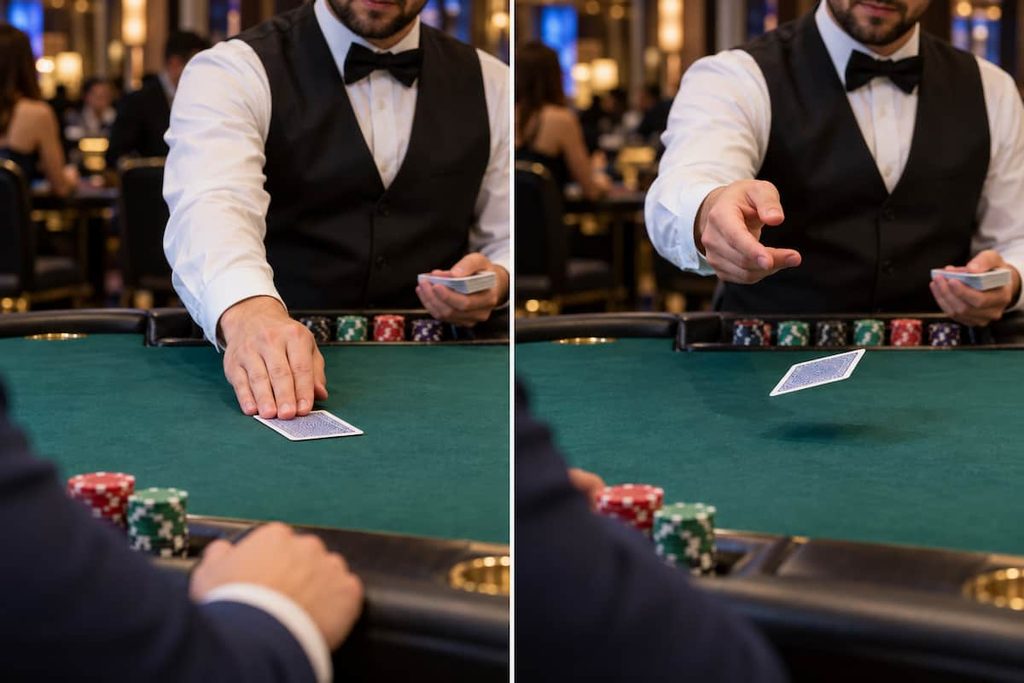
Slide Dealing vs. Pitch Dealing
With slide dealing, the dealer pushes each face-down card along the felt. With a traditional pitch, the dealer flicks the card through the air, creating more opportunity for it to flash. Here is how the two differ:
A manager’s case for changing the deal
The Venetian has not provided a management quote in the report, but South Point poker room manager Jason Sanborn explained why his room adopted the same basic approach in August. He said the change followed discussion of game protection and emerging devices, including cameras, smart glasses and hearing devices.
Sanborn’s explanation was direct: “Going to the slide pitch provides the best protection against exposed cards that we can currently do as operators.” He also said he did not think banning electronics at the table was reasonable, presenting slide dealing as a way to reduce card exposure without imposing a blanket phone ban.
That is an operator’s rationale, not proof that slide dealing eliminates cheating. The procedure may make one specific method harder, while leaving other vulnerabilities untouched.
Have players been cheated during a traditional deal?
Yes, there are documented cases involving attempts to capture cards as they were dealt, though the public evidence does not establish that every poker room using a traditional pitch is at risk or that the Venetian changed its procedure after a specific incident.
In a 2024 French casino case, police alleged that two men used modified mobile phones to photograph cards during blackjack and poker games. One device was placed near the table, while another was concealed on a player. The images were reportedly relayed to accomplices, who sent information back through tiny earpieces. Police said the group had allegedly won about €200,000 from one casino. The case was reported as an alleged cheating scheme, not a proven example of AI being used to read cards.
Other major cheating allegations have involved different technology. In 2025, US prosecutors alleged that a private poker ring used rigged Deckmate 2 shufflers and other devices to learn cards and influence play. Those allegations show why game security involves more than how a dealer pitches the cards; they do not show that the Venetian or any other casino was involved.
The claim circulating on X
Johan “YoH ViraL” Guilbert argues that hidden cameras, AI and concealed earpieces are being used by cheaters in cash games and tournaments worldwide, and calls for slide dealing to become mandatory.
The documented cases support concern about covert cameras and communication devices. But we found no reporting that verifies the post’s broader claim that AI-connected systems are widespread in both cash games and tournaments. Nor does the existence of camera-based cheating prove that slide dealing alone is a complete solution.
PokerType has covered how online security failures create a different route to players’ hole cards, including the Jurojin software attack and the wider online poker superuser allegations. Live and online games face different threats, but both depend on operators explaining what their safeguards can and cannot prevent.
Will slide dealing become standard?
The Venetian’s move, after South Point’s, gives the practice more visibility in Las Vegas. PokerStars has also used slide dealing at European Poker Tour events, while some players and dealers have questioned whether it slows the game or makes dealing less comfortable.
The next test is whether rooms can adopt the method consistently without creating new problems for dealers or players. Slide dealing can reduce the chance that a pitched card is exposed, but it should sit alongside trained staff, table rules, surveillance and secure handling of shufflers.
For now, the Venetian’s change is best understood as a precaution prompted by a real integrity concern. It is not evidence that the room found a cheating ring, and it does not establish that every poker room must use the same procedure. It does show that card protection is becoming part of the live-poker conversation.